
Trophic AI
How artificial intelligence is restructuring the enterprise technology ecosystem, told through the lens of the most famous ecological experiment in American history.

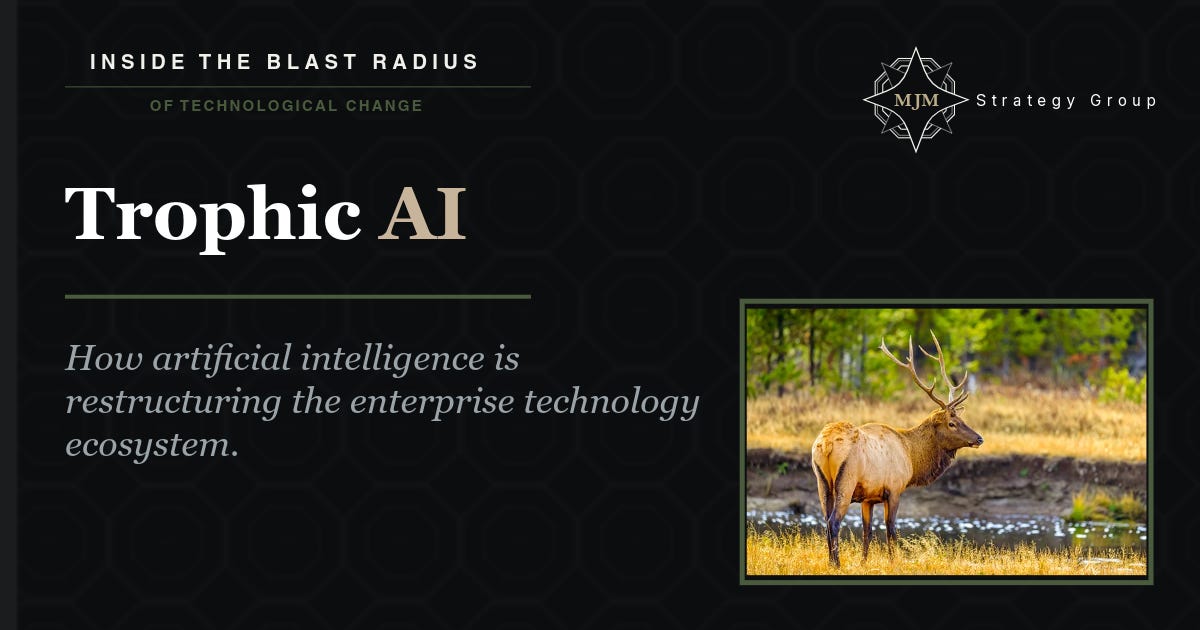
The Predator
Arrival, resistance, and the ecosystem before the hunt.
In the winters of 1995 and 1996, federal wildlife officials released 31 gray wolves into Yellowstone National Park, an ecosystem that had not known an apex predator in seventy years. The northern Yellowstone elk herd, roughly 20,000 animals, had spent those decades grazing without constraint, browsing young willows and aspens to bare dirt, eroding riverbanks, and degrading habitat so thoroughly that only a single beaver colony remained in the entire park. Not even the biologists responsible for the wolf restoration appreciated the impact the absence of wolves created.
The wolves changed everything, but not the way most people assume. Direct predation reduced the herd, but the larger effect was behavioral. Elk could no longer stand in one place and consume everything within reach. They had to move, stay vigilant, rotate through terrain. That behavioral shift set off a trophic cascade. The indirect effects of a top predator rippled downward through an entire food web. Willows grew back, aspens regenerated, beavers returned and built dams that raised water tables and created wetland habitat. Songbirds repopulated, fish thrived in deeper, cooler pools. The rivers themselves changed course as root systems stabilized their banks. A 2024 study measured a 1,500% increase in willow crown volume over the two decades following reintroduction.
WHAT IS A TROPHIC CASCADE?
A trophic cascade occurs when changes at the top of a food chain trigger a chain reaction through every level below. The reintroduction of wolves to Yellowstone is the most studied example in ecological science.
The term comes from the Greek trophikos, meaning nourishment or feeding. In a three-level cascade, a predator suppresses a herbivore, which releases vegetation, which transforms the physical landscape.
The same dynamic applies to industrial ecosystems. When a new force enters at the top of a value chain, the effects ripple through every layer of the system, often in ways that were not predicted.
Wolves restructured a 2.2-million-acre ecosystem by changing the rules under which elk operated. Three decades later, Yellowstone is widely understood to be healthier, more resilient, and more ecologically dynamic than the overgrazed landscape that preceded reintroduction. Scientists are still debating and discovering effects they did not fully predict.
The Trophic Cascade is the framework for understanding what artificial intelligence is doing to the enterprise technology ecosystem. The Yellowstone story is not a one-to-one map, but it is a powerful lens: once a new force changes the rules at the top of a system, the rest of the system begins to reorganize around it.
The Resistance
When wolves were proposed for Yellowstone, ranchers, hunters, and politicians mounted fierce opposition. They predicted the destruction of the elk herd, the collapse of the local economy, and the end of a way of life. The resistance was organized, emotional, and politically potent. It delayed action for years.
AI is meeting the same wall. A March 2026 Quinnipiac University poll found that 80 percent of Americans are somewhat or very concerned about AI, 76 percent say they trust AI-generated information hardly ever or only sometimes, and 70 percent believe AI will reduce job opportunities.
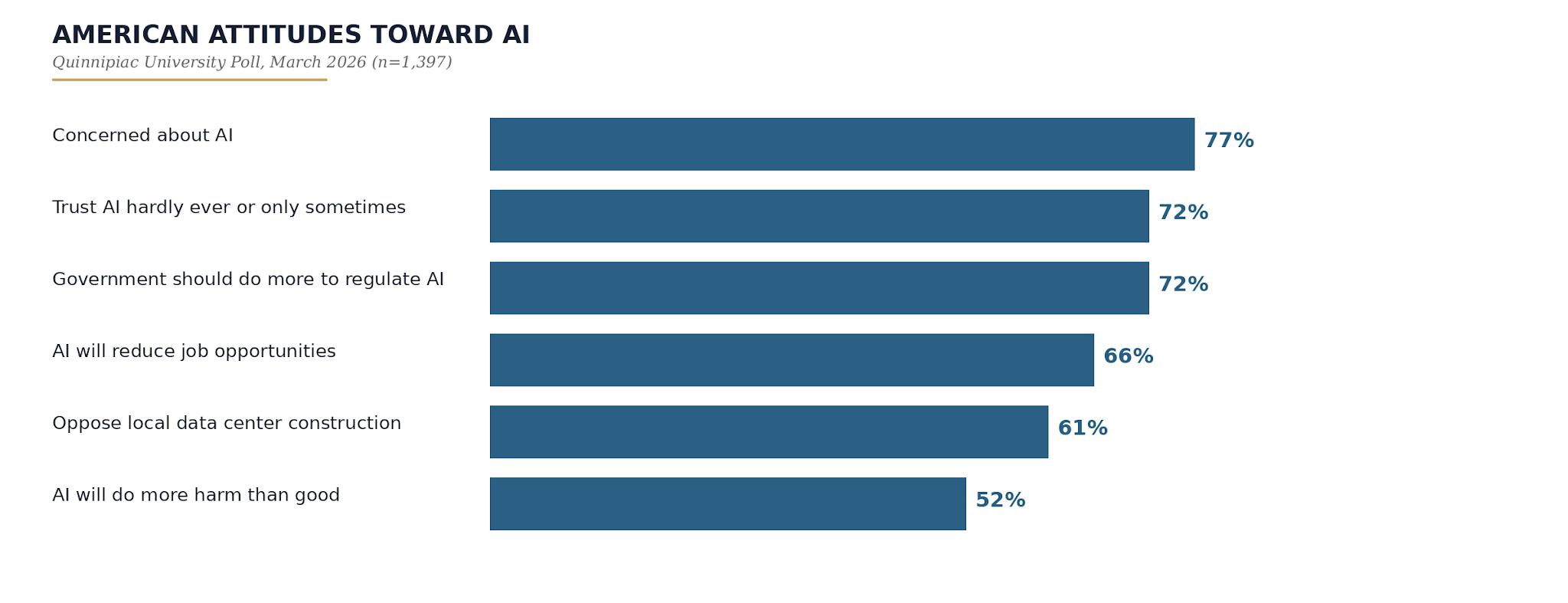
Source: Quinnipiac University, March 2026 (n=1,397).
The sentiment, pattern, and broad direction will feel familiar. Economic forces do not move exactly like ecological ones, but public resistance rarely stops a major capability shift once it begins to create visible advantage. More often, it accompanies the transition.
Opportunity Rich Environment
For twenty years, the enterprise software ecosystem operated without a natural predator. SaaS companies multiplied into every niche of organizational life: CRM, project management, HR workflows, expense reporting, marketing automation, business intelligence. The model was elegant and self-reinforcing. Digitize a business process. Sell access on a per-seat monthly basis. Lock customers in through data gravity and integration complexity. Watch revenue compound. During the pandemic peak, SaaS companies traded at 18 to 19 times revenue.
The systems integrators fed on this abundance. Accenture, Deloitte, Infosys, Wipro, and dozens of smaller firms built massive practices around the complexity that SaaS proliferation created.
Every new platform required implementation, configuration, customization, and integration with whatever came before it. The strategy engagement led to the implementation project that led to the managed services contract that led to the next upgrade cycle. Layers of organisms feeding on conditions created by the layer below. SaaS complexity fed consulting revenue the way overgrazed willows fed elk. This is where the analogy is particularly strong.
From the outside, the ecosystem looked prosperous. From the inside, the picture was different. In December 2024, Microsoft CEO Satya Nadella argued on a podcast that many business applications could “collapse” in the agent era. The comment set off a shockwave, but it articulated something that enterprise operators had been experiencing for years. The tools were expensive to purchase, expensive to implement, expensive to maintain, and widely resented by the people required to use them. Industry analysts have long documented the phenomenon of shelfware: enterprise software that is licensed, deployed, and then underutilized because the applications demand structured inputs from people whose work is unstructured, offering little visible return for the effort of compliance. Data quality degrades. Workarounds proliferate. Organizations hire analysts to clean up the mess, and consultants to optimize the tools that were supposed to eliminate the need for consultants.
The switching costs that protected SaaS valuations were never a sign of product affection. They were a function of integration complexity and sunk-cost psychology.
Many organizations did not stay on these platforms because the platforms were beloved. They stayed because leaving felt harder than enduring. The herd was fat, but the ecosystem underneath was degraded. It was Yellowstone in the early 1990s: an unchecked population consuming its own habitat, waiting for a force that would change the calculus of standing still.
Evolving Predation
The early large language models of 2022 and 2023 were the equivalent of the first wolves in the Lamar Valley. Impressive but limited. They hallucinated. They made errors confidently. They could not execute multi-step workflows reliably. Enterprise software CEOs assessed the new arrival and concluded it was manageable. AI would be a feature, they said. A copilot acting as an enhancement to existing platforms.
“There’s a new programming language. This new programming language is called human.” — Jensen Huang, CEO, NVIDIA
By late 2025, the models had matured rapidly. In a growing number of settings, AI agents could schedule meetings, draft contracts, update CRM records, generate analytical reports, manage project workflows, and write increasingly production-ready code without ever moving through the traditional user interfaces built for those tasks. The user-interface layer that SaaS companies had spent two decades perfecting was beginning to be bypassed.
VULNERABILITY SPECTRUM
Most at risk: project management, basic analytics, content management, customer service, marketing automation. These sit in the probabilistic middle where AI substitution is already viable.
Least at risk: security, compliance, infrastructure monitoring, financial controls. These operate in deterministic, high-consequence environments where precision and auditability still require dedicated systems.
Simultaneously, AI began to weaken the second pillar of the SaaS business model: switching costs. If more of the intelligence sits in the model rather than the application, the application itself starts to look more like a commodity. Data portability, the most effective lock-in mechanism in enterprise software, matters less when an agent can query, transform, and move data across platforms autonomously. And the pent-up desire to leave platforms that users never loved made the cost of entry even thinner than the valuations implied. The moment a credible alternative appeared, loyalty began to erode. The doors opened to change.
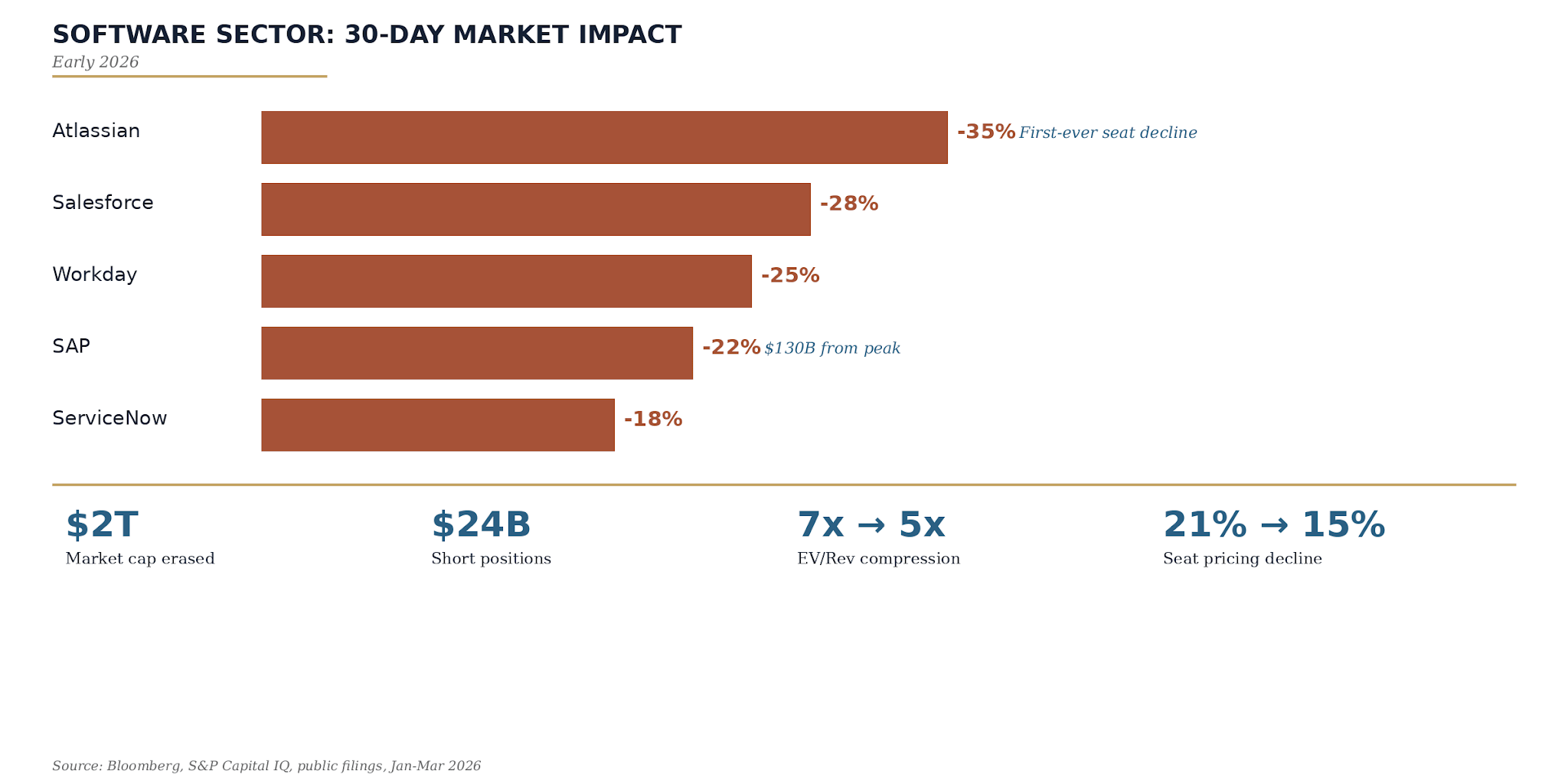
The market began to tell the story in financial terms. Software valuations compressed sharply in early 2026, and several marquee names traded well below prior highs even as AI investment accelerated. The stock market is a lagging indicator of something more structural. The real cascade unfolds in three stages, each requiring CEO leadership to initiate.
The Enterprise Trophic Cascade
Stage One: Functional Replacement. A CEO authorizes the evaluation and replacement of enterprise software function by function. The replacement happens tool by tool because that is how budgets are organized, but the decision to pursue it must come from the top. Klarna is one of the clearest examples: CEO Sebastian Siemiatkowski has described moving away from Salesforce and Workday, shrinking the company’s SaaS footprint dramatically, and lifting revenue per employee from roughly $400,000 to roughly $700,000. Each canceled contract and each eliminated implementation is pressure on an incumbent. Some of that pressure shows up as lost revenue. Most of it shows up as the quieter work of having to become something different.
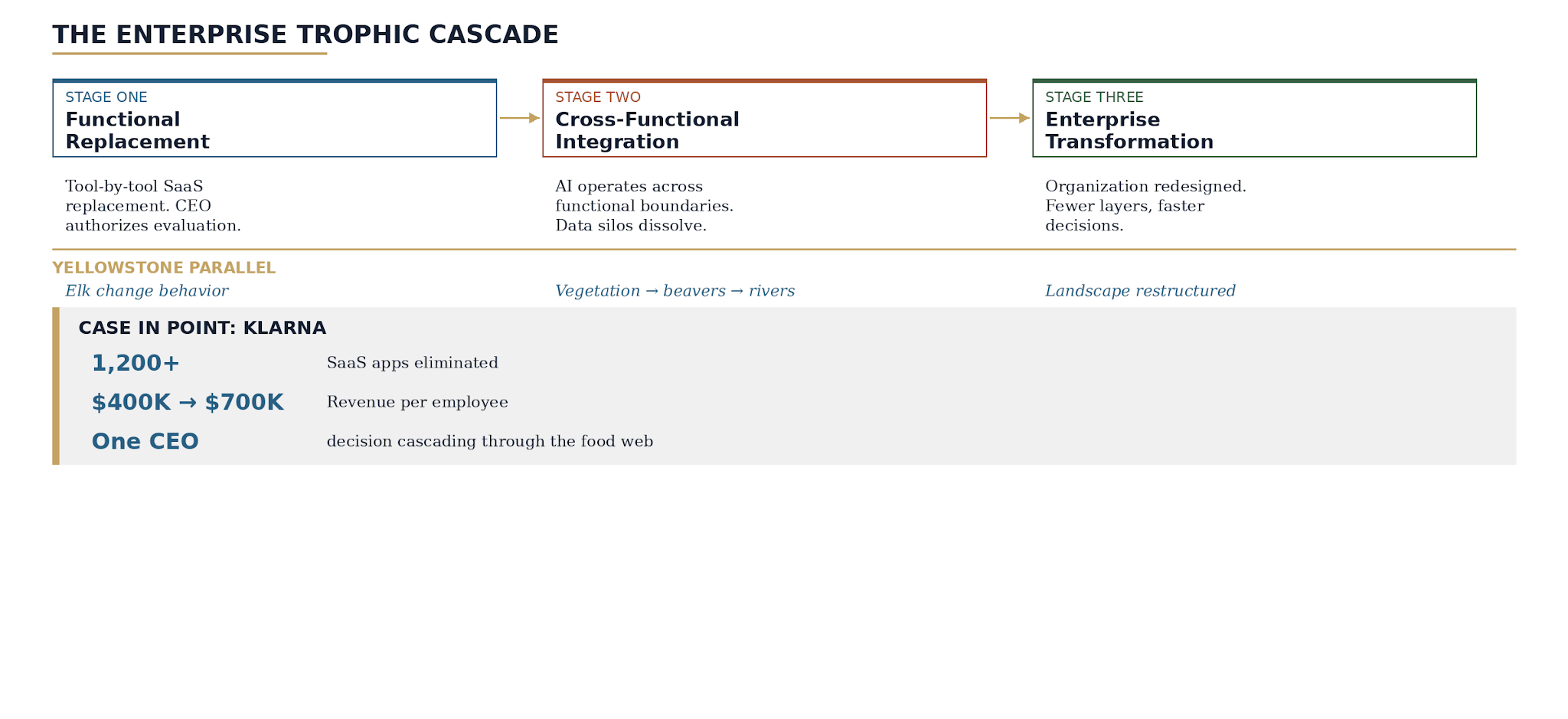
Stage Two: Cross-Functional Integration. This stage begins when agentic and multi-agent AI matures to the point where it operates across functional boundaries. The reason organizations buy enterprise software has been the data organization and reporting that the software enables. Each platform creates a functional data silo. The software reinforces organizational structure. AI does not respect functional boundaries. When a multi-agent system can aggregate data across CRM, ERP, HCM, financial planning, supply chain, and clinical operations simultaneously, the question shifts from which tool does my department need to what does the organization need to know and decide?
Every SaaS platform purchased is a vote for functional separation — directly descended from the assembly line.
Stage Three: Enterprise Transformation. This is where the CEO’s role shifts from authorizing change to redesigning the organization itself. If AI operates across every function simultaneously, the layers that existed to translate between silos become unnecessary. The middle-management architecture built around information flow between functions was an artifact of a world where humans were the only mechanism for cross-functional synthesis. AI makes that architecture optional. The organization gets flatter, faster, and more directly connected between strategy and execution.
The three stages will overlap. Some organizations are already in stage two. A handful of AI-native companies were born in stage three and never knew the old model. For most enterprises, the progression will be sequential, gated less by technology than by the willingness of senior leaders to rethink their tools and their organizational design.
The Integrators - Margin Made of People
The consulting and systems integration industry is built on a pyramid. A small number of partners sell work, set strategy, and manage client relationships. Below them, managers and senior consultants scope and oversee projects. Below that, a much larger base of analysts, junior consultants, and implementation specialists do the bulk of the billable work: building decks, running analyses, configuring systems, writing documentation, testing integrations, populating templates.
The economics depend on the base being wide. Partners bill at $500 to $1,200 an hour. Analysts bill at $150 to $250. The margin is made on the spread, and the spread requires volume. A typical implementation project might staff two partners, four managers, and twenty analysts. The partners are the client relationship. The analysts are the margin.
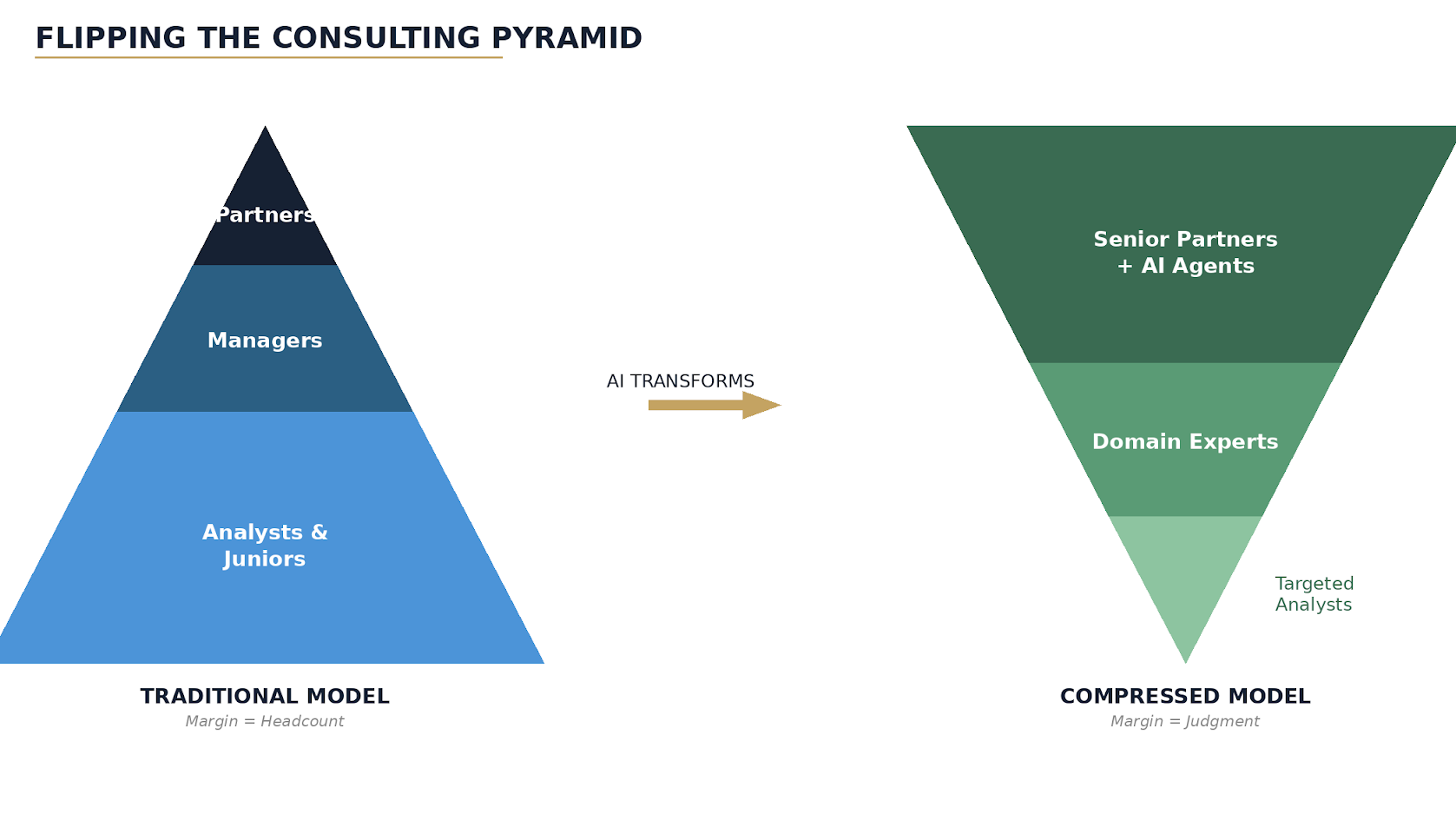
AI is compressing the base of the pyramid. When a partner can use AI to do the analytical work that previously required a team of six, the team of six is not needed.
Accenture and TCS have both announced significant workforce reductions, even as large firms continue to report substantial bookings and revenue. The market is repricing not just current performance, but the future shape of the business.
The pyramid is being compressed. Senior partners using AI and agentic systems can do a meaningful share of the work that once required a much broader team, in less time and at lower cost. New approaches to scope, delivery, and pricing are emerging, often to the client’s advantage. Much of the analytical and documentation work that drove firm margin is being absorbed by the models. The organizational change this represents is profound, but it is change, not ending. The elk herd at Yellowstone did not disappear after the wolves arrived. It became smaller, leaner, more vigilant, and more mobile. The integrators who will still be here in a decade are already reorganizing around the same logic: fewer people per engagement, more senior judgment, AI doing the heavy analytical lift, and a sharper thesis about what the firm actually sells. The work is not going away. The shape of the firm that does it is.
Competition Driven Abundance
The Yellowstone story does not end with the die-off. It ends with regrowth. The regrowth was more diverse, more productive, and more resilient than what it replaced. Willows grew back along the streams. Beavers returned and built dams that created entirely new wetland ecosystems. Songbirds repopulated. The coyote population, which had dominated the small-predator niche in the absence of wolves, was reduced by 90 percent, and pronghorn antelope fawn survival rates tripled as a result. Each organism filling a niche that the old, overgrazed ecosystem had suppressed. The enterprise technology ecosystem is beginning to exhibit the same pattern.
New Growth
Start with the engineers. Job postings have rebounded sharply from the 2023 trough, and demand has shifted toward people who can build, deploy, and orchestrate AI systems rather than simply configure SaaS platforms. Companies are hiring different engineers now. These are the songbirds returning to a canopy that is growing back.
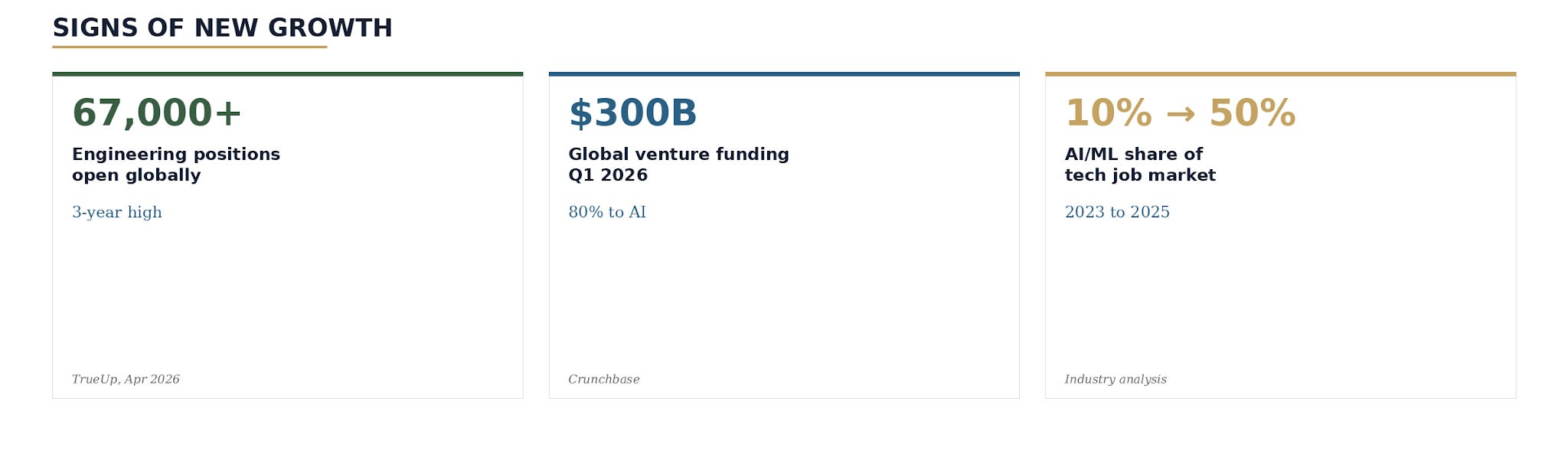
AI-native startups are the beavers, and Q1 2026 made the scale of their emergence unmistakable. Investors poured roughly $300 billion into startups globally in the first quarter of 2026, the largest venture quarter on record, with AI absorbing the clear majority of that capital.
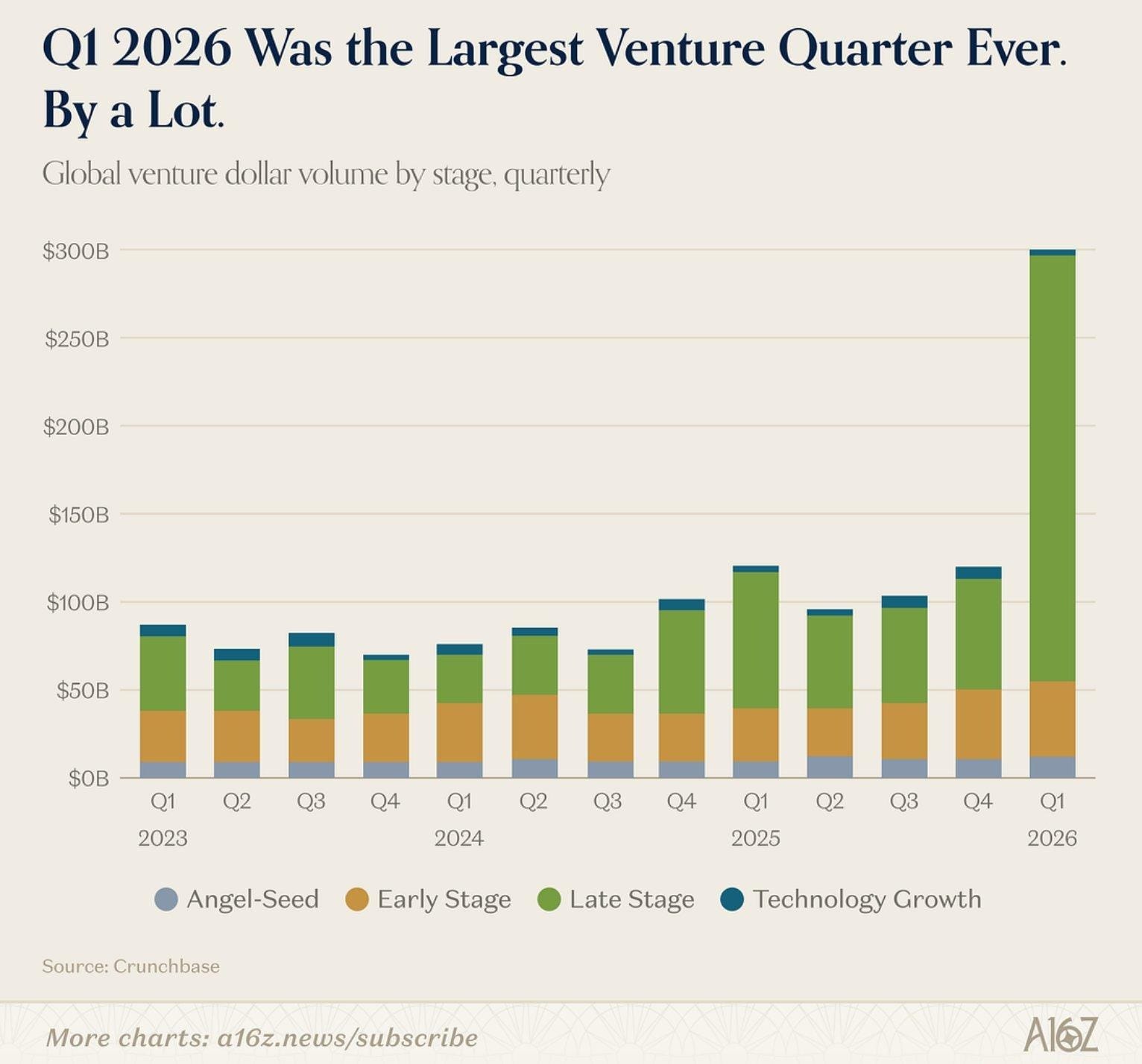
These companies are building new infrastructure in places the old ecosystem never reached, creating pools of capability and economic geography that did not previously exist.
New Species
A useful way to read the new ecosystem is by the kinds of organisms it is producing. Four groups are particularly worth naming, not because any of their members is guaranteed to dominate but because together they describe how the food web is reorganizing.
Foundation Labs. Most obviously, at the top of the food web sit the labs that build the models themselves: OpenAI, Anthropic, Google DeepMind, xAI, Meta, Mistral, and a small number of others. They are the closest analog the enterprise ecosystem has to the wolves, in that their capabilities set the rules under which every other species operates. Their economics are not like anything the software industry has seen. OpenAI has been valued in the range of $850 billion in 2026 financing activity; Anthropic sits well above $300 billion with annualized revenue reportedly moving from $9 billion at the end of 2025 toward $19 billion by early 2026. These are compute-intensive businesses with enormous fixed costs, tight supply of chips and energy, and a small number of genuinely competitive frontier labs. They are not safe. They are expensive to run, subject to regulatory attention, and dependent on a capital cycle that will eventually demand returns commensurate with the bets being made.
AI-Native Services Firms. A second tier is emerging between the labs and the enterprise: services firms built from the ground up around AI rather than retrofitted to it. Distyl, founded by former Palantir engineers and valued around $1.8 billion in late 2025, positions itself as a deployment partner that moves Fortune 500 clients from pilots to production in weeks rather than quarters, often in partnership with OpenAI on the underlying models. Ciklum, with four thousand engineers across Europe, the United States, and Asia, has repositioned a mature offshore engineering business around AI-enabled delivery for financial services, retail, travel, and healthcare clients. Others are specializing by industry, by function, or by engineering discipline. What these firms share is an operating model that assumes AI is doing a meaningful share of the work, which allows them to deliver at price points and timelines the traditional integrators struggle to match.
Agentic Platforms. A third group is building the tools that let other organizations create agents of their own. Anysphere’s Cursor, by some reporting the fastest-growing software product in history, crossed $2 billion in annualized revenue in early 2026 and sits among the most valuable private companies in the sector. Cognition, maker of the Devin coding agent, acquired Windsurf in 2025 and is working to embed autonomous engineering capability into the everyday developer workflow. Sierra, founded by former Salesforce co-CEO Bret Taylor, passed $150 million in annual run rate in the customer experience category, with outcome-based pricing that reflects the shift from software licensing to paying for work completed. These are platform businesses in the classical sense: the more companies that build on them, the more entrenched they become, and the more they shape how the next layer of the ecosystem develops.
The Vertical Specialists. The fourth group is building domain-specific capability into narrow enterprise niches. In legal, Harvey has reached valuations north of $5 billion by serving the largest U.S. law firms and corporate legal departments. In financial services, firms like Hebbia and Rogo are embedding agentic analysis into diligence, research, and underwriting workflows. In healthcare, Abridge has moved from clinical documentation into revenue cycle intelligence, OpenEvidence is used daily by roughly forty percent of practicing U.S. physicians, and Hippocratic AI is building agents for non-diagnostic patient interaction. In defense and government, Anduril and Palantir continue to expand the envelope of what agentic systems can do in environments where the traditional SaaS stack was never credible in the first place. These specialists are filling niches the old monoculture of horizontal software could never reach deeply enough to serve.
Running through all four groups is capital at a scale the enterprise software industry has not previously seen directed at new entrants. The $300 billion first quarter of 2026 is the headline number, but the more important statistic is that the majority of it flowed to companies less than five years old. That is the hydrology of the new ecosystem: water moving through channels that did not exist in the old landscape, feeding growth in places the old map did not show.
THE RISE OF VERTICAL AI
For two decades, horizontal SaaS platforms tried to serve every industry with general-purpose tools. Healthcare, legal, manufacturing, logistics, and financial services all squeezed domain-specific needs into platforms designed for nobody in particular.
AI-native vertical solutions are now reaching these markets with purpose-built capabilities that understand the domain deeply enough to deliver outcomes, rather than features. These are the specialists filling niches that the old monoculture suppressed.
And yet, the cascade is not slowing down. It is accelerating into a phase that threatens to reorganize the new ecosystem as thoroughly as the first wave reorganized the old one.
What Comes Next
OpenAI’s partnership with OpenClaw is one signal. OpenClaw is an open-source agent framework, barely six months old, that lets anyone run an autonomous AI assistant on their own hardware, connected to the messaging apps they already use. It crossed 350,000 GitHub stars faster than React accumulated in a decade. Jensen Huang called it “probably the single most important release of software, probably ever.” NVIDIA did not compete with it. It built NemoClaw, a governance and sandboxed execution layer, around it. Tencent, Alibaba, and DigitalOcean launched one-click deployment. Chinese developers adapted it for DeepSeek and WeChat within weeks.
Think about what that means for the AI-native services firms and agentic platforms we just named. Their advantage rests on knowing how to build and deploy agents for enterprises that cannot yet do it themselves. OpenClaw, and the open-source movement it represents, compresses that advantage on a timeline measured in months, not years. When a competent operations manager can stand up an autonomous agent from a WhatsApp conversation, the specialized knowledge that justifies a services engagement begins to look like a depreciating asset. Some of these firms will adapt into deeper, more defensible positions. Others will discover that what they were selling was a temporary gap in capability, not a durable franchise.
Simultaneously, the open-source model ecosystem is closing the gap with the proprietary frontier. DeepSeek, Meta’s Llama, Mistral, and a growing cohort of open-weight models are delivering near-frontier performance at a fraction of the cost, often runnable on local hardware. NVIDIA has leaned heavily into this ecosystem, building inference infrastructure and tooling that makes open models viable for production enterprise use. The effect is to commoditize the model layer from below at the same moment that frameworks like OpenClaw commoditize the agent layer from above. The middle, where the AI-native services firms and agentic platforms currently sit, is being squeezed from both directions.
And then there is the longer horizon. At the India AI Impact Summit in February 2026, Google DeepMind CEO Demis Hassabis said that AGI, a system with all of the cognitive capabilities of the human mind, has “a very good chance of being within the next five years.” He quantified the impact as “something like 10 times the Industrial Revolution, but happening at 10 times the speed, probably unfolding in a matter of a decade rather than a century.” Hassabis is not a casual commentator. He is a Nobel laureate running one of the three or four labs most likely to build it. If he is even directionally correct, then the cascade we have described in this paper, the reorganization of the enterprise technology ecosystem around AI agents and foundation models, is itself a transitional phase. What comes after AGI is not an extension of the current trend. It is a different kind of system entirely, and the organizations that thrive in it will be the ones that have already built the muscle to reorganize repeatedly rather than once.
The cascade described in this paper may be the warm-up. The question is not whether your organization can adapt to AI agents. It is whether you are building an organization that can keep adapting when the agents themselves are replaced by something we do not yet have a name for.
Pronghorn Effect
When biologists planned the Yellowstone reintroduction, nobody predicted how many secondary effects would follow. The cascade produced ecosystem-level changes outside any model. Wolves killed coyotes and fewer coyotes led to a resurgence of pronghorn calves and growth in their general population, a significant third-order effect.
The enterprise cascade is producing its own pronghorn effects. Engineering job postings have rebounded sharply from the 2023 trough, with demand shifting toward people who build, deploy, and orchestrate AI systems rather than configure SaaS platforms. The share of AI and machine learning roles in the tech job market expanded from 10 percent in 2023 to 50 percent in 2025. Companies are hiring different engineers now. These are the songbirds returning to a canopy that is growing back.
The most unexpected signal is the growing demand for people who can think, write, and reason about complex problems in ambiguous contexts: the skills traditionally associated with the liberal arts and humanities.
AI reduced the value of routine analytical work, which shifted the premium to the integrative, communicative, and ethical reasoning that the humanities have always cultivated.
The demand for liberal arts and English majors is a third-order effect, and one few people predicted. To wit, Daniela Amodei, co-founder of Anthropic, studied literature in college and has said that when her company hires, it looks for great communicators because the things that make us human will matter more. Jensen Huang has argued that the programming language of the future is human language, and has encouraged young people heading to college to focus less on coding and more on the sciences and skills that AI cannot replicate. Apple recruits from the humanities because designing products people want to use requires empathy and cultural awareness. Microsoft has added ethicists and humanists to its AI teams. Google employs philosophers, linguists, and sociologists to address algorithmic bias and inclusivity.
No Permanent Apex
It would be a mistake to read the new ecosystem as a simple story of winners replacing losers. The Yellowstone cascade continued well past the reintroduction. Wolf populations themselves went through boom and bust cycles as prey density shifted. Rival packs fought for territory. Disease moved through the population. The ecosystem kept rearranging itself, and no single species held its position for long.
The enterprise cascade is already showing the same pattern. Each of the new species faces its own version of predation. The foundation labs are capital-intensive, regulated, and dependent on a tight supply of chips and energy; the economics that justify their valuations today are not guaranteed to hold. The AI-native services firms are built on a temporary asymmetry, that their people know how to wield AI for enterprises that do not yet. As natural language becomes the default programming language and as agent-building becomes something a competent operator can do from a browser, the specialized knowledge that defines these firms today becomes more broadly distributed. Some will adapt into something more defensible. Some will be acquired. Some will find that the moat they thought they had was always a puddle.
The agent platforms face the threat of commoditization from below and disintermediation from above. As foundation labs push further up the stack with their own agent-building tools, the middle layer gets squeezed. The vertical specialists face the opposite risk: that the platforms they sit on will eventually learn their domain well enough to serve it directly. Even the incumbents the cascade is pressuring today, the large SaaS vendors and traditional integrators, are not guaranteed to lose. Epic is building its own AI tooling for health systems. Accenture, Deloitte, and the major Indian services firms are reorganizing around agentic delivery at meaningful speed. A leaner, AI-augmented version of the traditional integrator may turn out to be more resilient than many of the startups that currently appear to be eating its lunch.
The question for any organization in the new ecosystem is not whether it has an advantage today, but whether it has built the muscle to find the next one when today’s advantage closes.
This is the nuance the straight-line narrative misses. The cascade is not a single move from one equilibrium to another. It is a continuing reorganization in which every position is provisional. Some firms that look like prey today will adapt and become harder to catch. Some firms that look like apex predators today will find the conditions that made them apex have already changed. The only durable position is the willingness to keep adapting.
Which is the right place to turn to the question of leadership.
It Isn’t an Adventure If You Know What Happens Next
The technology required for the cascade is here. The gating factor is leadership. Moving through the three stages of this transformation requires a CEO with four specific capabilities, none of which are technical.
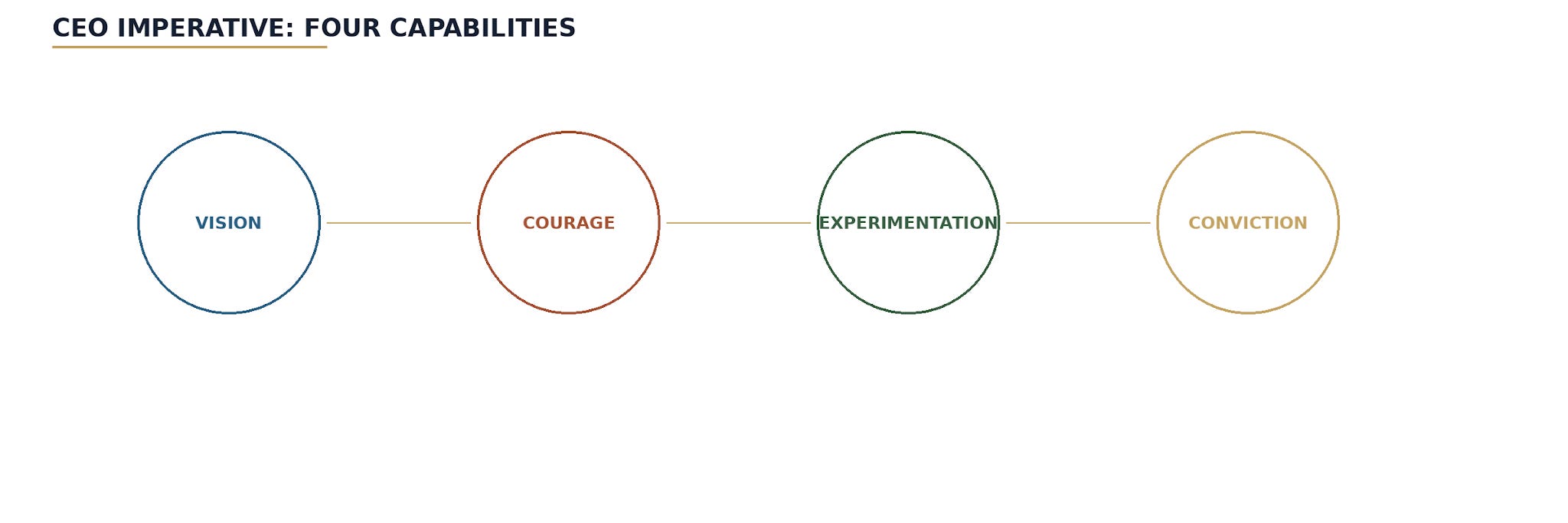
Vision to see that this is an organizational redesign, not a technology upgrade. The shift from functional SaaS to enterprise-level AI is a structural decision about how the company operates, makes decisions, and creates value. A CEO who delegates this to the CIO has already lost the thread.
Courage to act before the path is fully clear. The CEOs who move first will face resistance from incumbents inside their own organizations: functional leaders protecting budgets, IT departments defending platforms, middle managers defending their layers.
Risk tolerance for experimentation because the cascade will produce surprises. The organizations that succeed will treat the transformation as a series of experiments, learning and adjusting as the system responds.
Confidence in the direction even when the destination is not fully visible. The biologists who championed the reintroduction knew the ecosystem would respond. They could not have told you how every species would adapt. They acted on the conviction that restoring the predator would restore the system, and they were right in ways they could not have imagined.
These are the traits of a founder building something new.
The question for every CEO reading this is not whether the cascade is happening. The question is what you become in the ecosystem that is forming. The elk that learned to move became leaner and more resilient. Now is our time.
There is no more exciting time to be alive.
Michael Main
Principal, MJM Strategy Group, LLC
Michael.Main@MJMStrategyGroup.com
An AI-native healthcare strategy advisory firm. Michael brings 25 years of C-suite consulting experience from Monitor Deloitte, Accenture, and Oliver Wyman to the intersection of artificial intelligence and enterprise transformation.