
The Enemy Is Us
Why AI transformation often fails and the litmus test CEOs must run before funding another pilot

I. THE PARADOX OF THE MOMENT
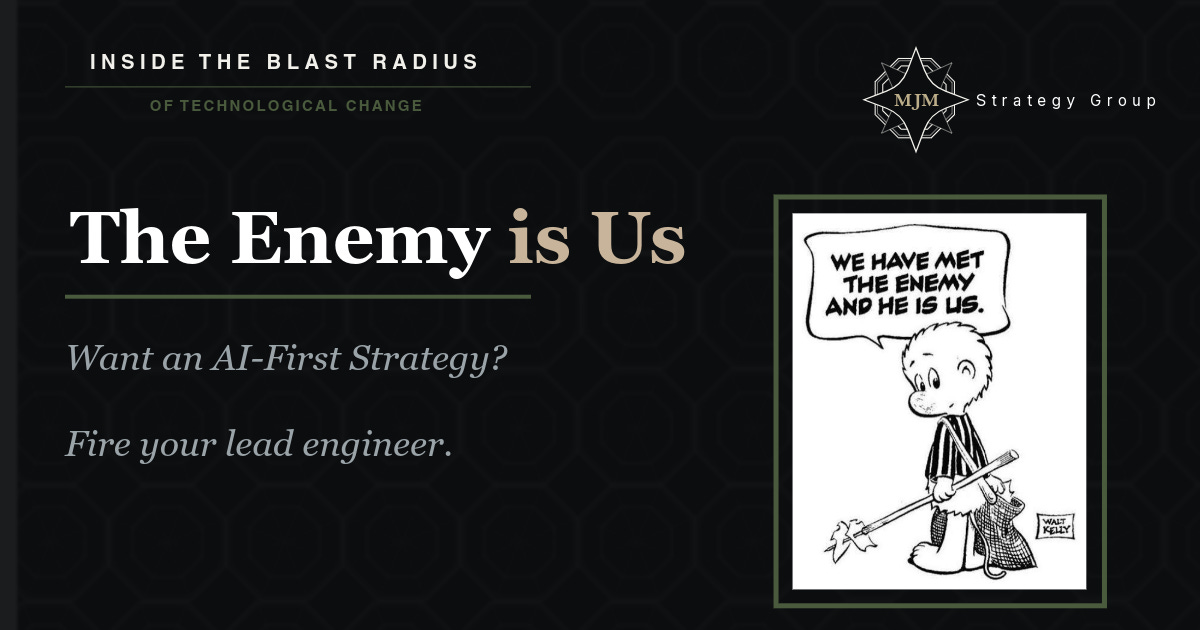
Want an AI-First Strategy? Fire your lead engineer.
We are living through the most advanced technology cycle in business history. And yet, never has a new technology been adopted this fast by individuals and failed this consistently at the enterprise level.
The research is clear on this. MIT’s NANDA initiative, drawing on 150 executive interviews, 350 employee surveys, and 300 public deployments, found that despite $30 to $40 billion in enterprise investment, 95 percent of generative AI pilots delivered no measurable P&L impact.1 S&P Global found the share of companies abandoning most of their AI initiatives jumped from 17 percent in 2024 to 42 percent in 2025.2 More recently, Gartner predicted that more than 40 percent of agentic AI projects will be canceled by the end of 2027.3 RAND pegs overall AI project failure above 80 percent, roughly double the rate of conventional technology projects.4
Now compare a second data set. The same MIT study found that 90 percent of workers use personal AI tools daily, most without official subscriptions, a shadow AI economy operating beneath the org chart. Your AI transformation is already underway. It just was not invited to the steering committee.1 McKinsey’s Superagency in the Workplace report reached a conclusion that every CEO and board should hear: employees are ready for AI, and the biggest barrier to scaling is leadership.5 Ironically, the executives surveyed were more than twice as likely to blame employee readiness as to blame their own role.
Reading those two data sets together, the conclusion is unavoidable. The technology helps work get done and individuals are adopting it at consumer speed (albeit with lumpy and often under-powered use cases). Enterprise failure’s root cause is leadership. When a project dies, the autopsy blames the technology: the model hallucinated, the vendor oversold, the data was not ready. These explanations are comfortable because they are external, and in the overwhelming majority of cases they are wrong. Curiously, no autopsy report has ever named its own author. MIT’s researchers were explicit: the core issue is not the quality of the models but a learning gap in how organizations integrate them.1 Boston Consulting Group quantified the same insight with its 10-20-70 rule: successful AI transformation is roughly 10 percent algorithms, 20 percent technology and data, and 70 percent people and processes.6 Most companies invert that ratio. Our management orthodoxies are failing the models.
The enemy is us. In my advisory work with CEOs and senior teams, I see four failure modes behind the statistics. The first three are failures of design. The fourth is the one nobody wants to write about, and it is the reason this paper is being advanced.
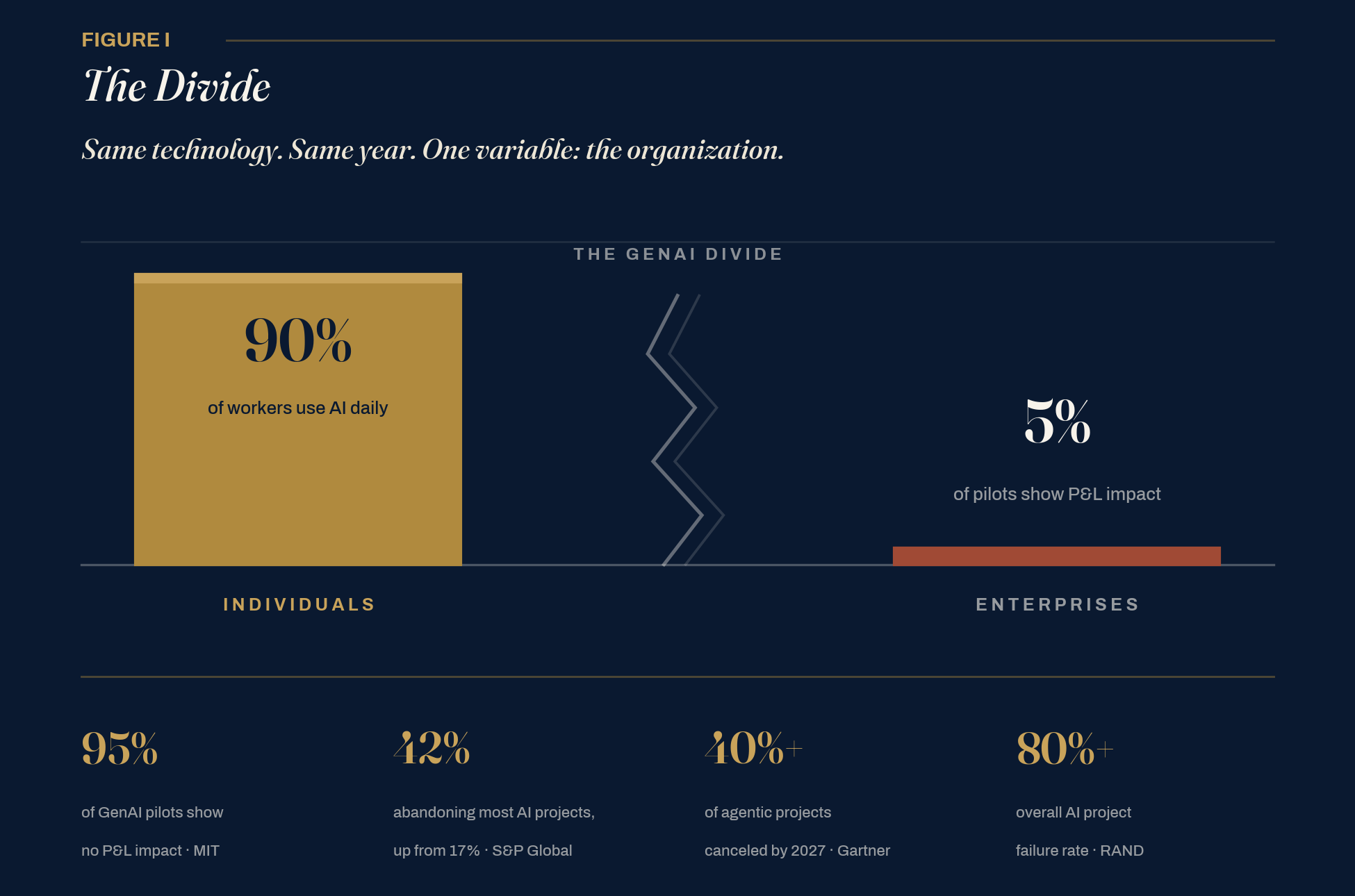
Sources: MIT NANDA Initiative 2025; S&P Global Market Intelligence 2025; Gartner press release, June 2025; RAND Corporation 2024. Ninety percent of surveyed workers report daily use of personal AI tools; five percent of enterprise pilots produced measurable P&L impact.
II. THREE DESIGN FAILURES
Vision, scope, and clear outcomes.
Failure one: experimentation without strategic vision. Most companies begin their AI journey the way a child opens a toy chest. Marketing builds a content generator, finance pilots a reconciliation bot, HR buys a screening tool. Experimentation is healthy; you learn a new medium by playing in it. The dangerous pathology is using experimentation as a substitute for strategy rather than an input to it. The portfolio of pilots maps to whoever asked first and creates the biggest buzz, not to where the enterprise creates and loses value. MIT found the pattern in the spending data: more than half of generative AI budgets flow to sales and marketing, while the largest measured returns sit in back-office operations and process automation.1 A strategic vision for AI is not a slide that says “we will be an AI-first company,” which is both ambiguous and rudderless. Rather, it is a specific answer to three questions. (1) Where in our value chain does intelligence, applied at scale, change our cost structure or our customer experience? (2) What will our industry’s economics look like when our competitors answer that question correctly? And (3) what sequence of capabilities gets us there before they do? If your AI portfolio cannot be traced, pilot by pilot, to that answer, you do not have a strategy and operating plan, you have a science fair. Good luck.
Failure two: soft scoping. The pilots that survive share a trait that the dead ones lack, brutal narrowness. The MIT study’s lead author noted that the startups outperforming enterprises “pick one pain point, execute well, and partner smartly.”7 Unfortunately, corporate instinct often runs the other way. Scope expands in the steering committee until the project is asked to transform a function rather than fix a workflow. Sharp scoping means choosing a single workflow with a measurable baseline, a defined user, proper engineering talent, precisely defined ROI and “go-no-go check points” (with root cause analysis as needed). Mapping the journey and understanding failure builds transformational muscle, as does resisting every stakeholder who wants their requirement bolted on. The discipline sounds trivial. In practice it is the most uncommon and yet most impactful skill in the room.
Failure three: ROI without a definition. Ask ten executives sponsoring AI projects how they will measure return, and you will get ten gestures toward “productivity.” In my experience, “productivity” is what executives say when the number does not exist. Few can answer the harder question: how is return measured and against what baseline? (How: in hours, in headcount, in cycle time, in revenue, in error rates? Banked when and by whom?) IBM’s 2025 CEO Study of 2,000 chief executives found that only one in four AI initiatives delivered the expected return. Much of that shortfall is measurement failure, a self-fulfilling prophecy in which pilots launched without predefined success criteria cannot be declared successes even when the technology performs exactly as designed.8 The fix is unglamorous: define the unit of value before the pilot starts, instrument the baseline before the tool touches it, and pre-commit to what number, by what date, constitutes success or failure. If the team cannot write that sentence, the project should not be funded. Defined this way, both the wins and the losses compound into future advantage.
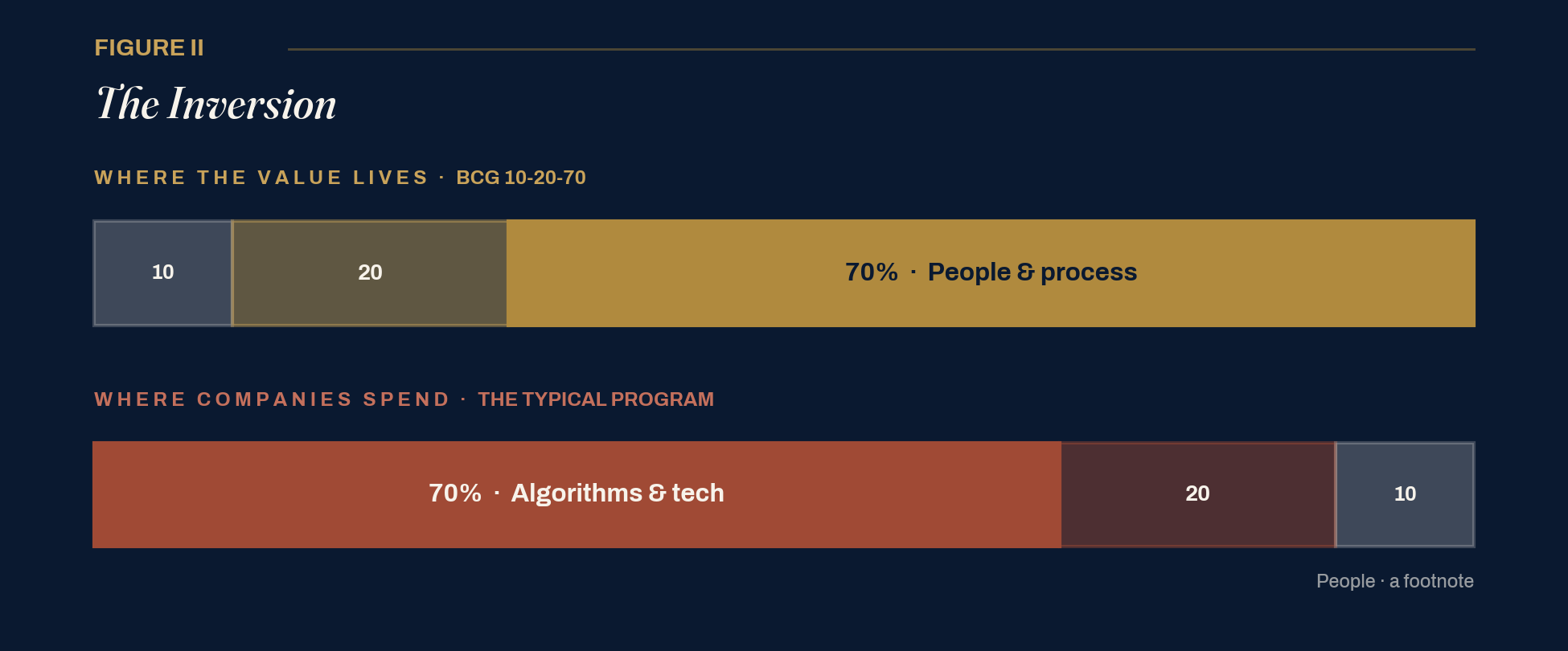
Source: Boston Consulting Group, the 10-20-70 framework for AI at scale. Successful transformation weights people and process at roughly 70 percent of the effort. Most enterprise programs spend in the mirror image.
Getting those three right, vision, scope, and ROI on paper, is the foundation of success. But there is an uncomfortable truth: you can still fail completely. Programs are not run on paper, they are run by people.
Some of the most critical people to the work experience this technology not as an opportunity but as an existential threat to their ego, pride and very livelihood.
III. THE FOURTH FAILURE: THE ENEMY
The executive in the mirror.
Let me share with you the story of three companies I have advised. The details are disguised, but the patterns are not. Unfortunately, they have been witnessed playing out across multiple organizations.
In each case, my client the CEO did nearly everything right. Real strategic intent, board alignment, funded roadmap, named use cases with defined value. The program was enthusiastically launched within the existing technology organization. What followed, in every case, traced to three archetypes of technology leadership, the very roles that were once the bedrock of technological progress.
Number one: Even seasoned executives can adopt unpredictable behavior when sufficiently threatened. The head of engineering at our first client simply lied. He reported progress on AI integration work that was not happening, presented demos that masked the absence of any production path (down-scoping work to meet his lack of progress) and bet that the hype cycle would crest before anyone audited the substance. Someone audited the substance. He was fired.
Number two: The next client proactively hired a new CTO with new AI skills and experience. He did not lie; he was fatally inflexible. He did something more common and equally tragic, he ran the new race with the old playbook. Eighteen-month delivery plans. Waterfall-style requirements gathered before anyone had touched a model. Procurement cycles designed for ERP systems applied to a technology that materially improves every quarter. He brought a Gantt chart to a gun fight. “Move fast and fail quickly” was not in his DNA. When the approach visibly failed, he could not adapt. His ego (being right) prevented him from admitting the playbook that built his career no longer worked. He was rigid until the day he was walked out.
Number three: Our third example, a technology chief (CIO), was neither dishonest nor dogmatic. Despite being hailed internally as the organization’s transformational leader, he was preoccupied with the familiar and simply absent from the innovative moment. He demonstrated no curiosity about the tools, no hands-on time with the models his teams were deploying, no appetite for failure as a learning mechanism, and no willingness to imagine what the technology made possible.
He was crushed by the halo his previous accomplishments had created.
We gathered that, like his peers above, he was threatened and afraid his inability to keep up would be discovered. He put his head in the sand and managed AI the way one manages a vendor risk. He delivered nothing and was pushed out.
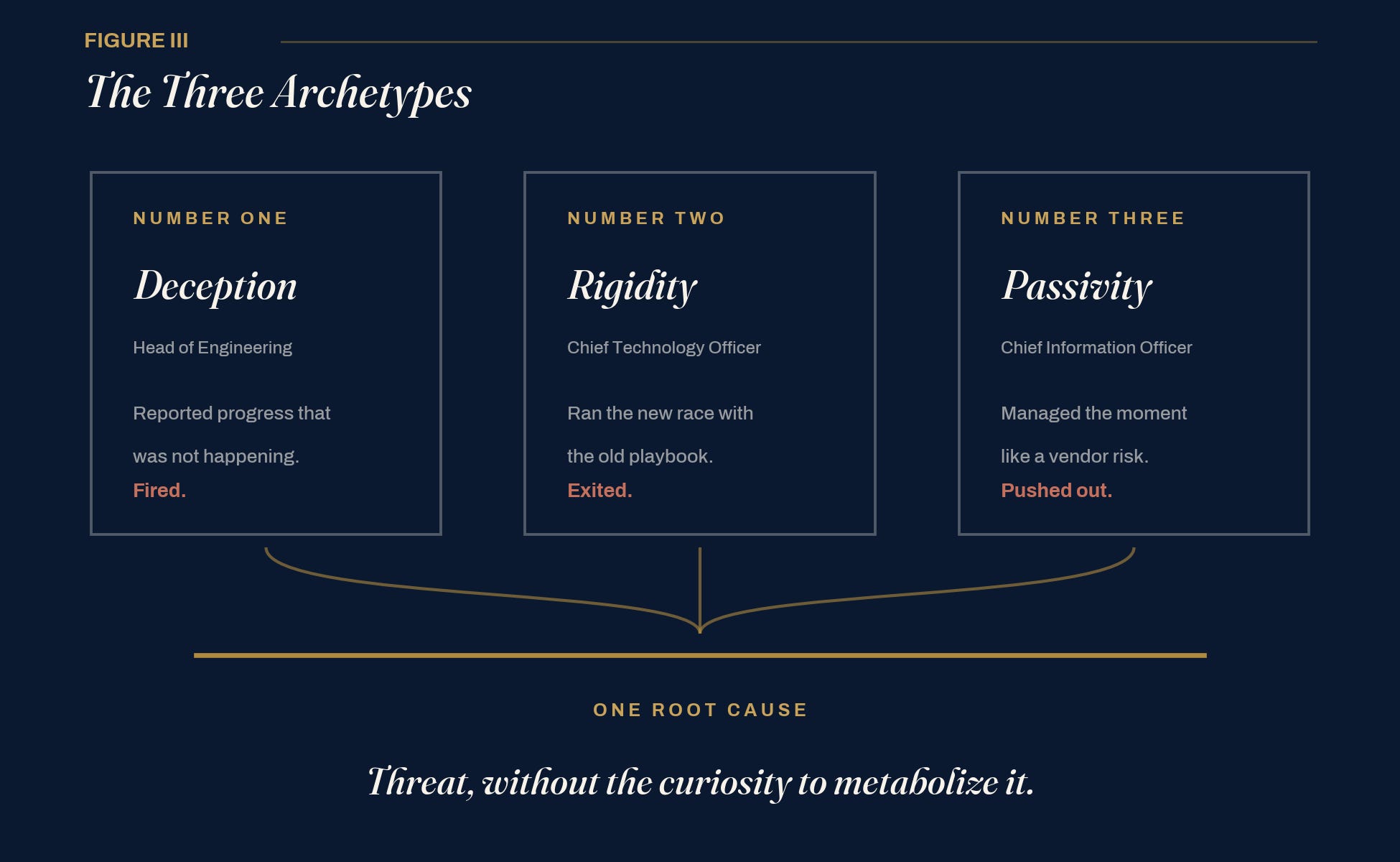
Three technology leaders, three surface behaviors, one underlying failure: each experienced AI as a verdict on his expertise and standing, and none could do the one thing the moment demanded, lead from a position of not knowing.
This is not an indictment of CIOs and CTOs as a class. Some of the finest AI leaders I know carry those titles. It is however an indictment of an assumption that organizations built to run yesterday’s technology are equipped to thrive in the modern era of AI. The traditional IT function is engineered for reliability, uptime, security, and cost control. Its incentives punish failure and reward predictability. AI transformation demands the opposite ethos: rapid hypothesis testing, cheap failure, continuous adaptive planning as the frontier moves, and comfort with probabilistic systems that will sometimes be wrong. Asking a leader optimized for the first regime to run the second, without first testing whether they can make the leap, is not delegation, it is managerial malfeasance.
The clearest manifestation of the GenAI Divide is not in the technology stack. It is in the org chart and the people occupying it.
The research validates the pattern at scale. MIT found that internally built tools succeed at half the rate of external partnerships (there is a call for new blood), a result that says less about engineering talent than about the incentives and mindsets governing internal builds.
IV. THE LITMUS TEST
Five probes critical to calibration.
If the binding constraint is the leader, then the CEO’s first AI decision is not which model to license or which use case to fund. It is a personnel decision, who on this team can actually lead in this new world? That question deserves the same rigor as a capital allocation. Thankfully it can be tested.
FIGURE IV
The Litmus
Five probes for every executive who will touch the AI agenda. The answers are observable, the failures are disqualifying, and the test takes one meeting.
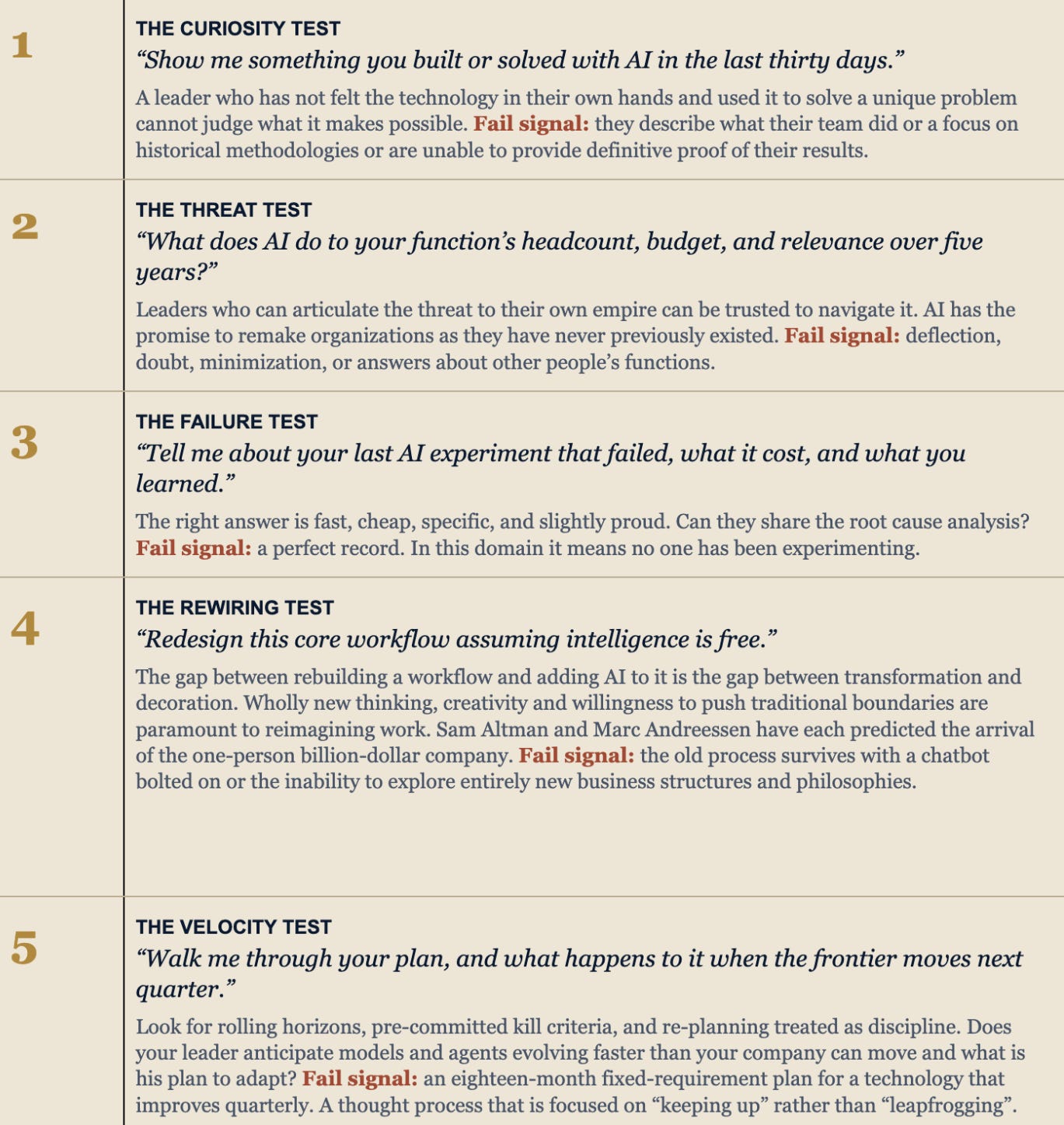
Run these probes honestly and the results may be uncomfortable. Some of your most accomplished, most loyal executives will fail them. You will be tempted to grade on a curve. Your competitors are counting on it. That is precisely the point. The traits that earned leaders their seats over the past twenty years, mastery of a stable domain, flawless execution against fixed plans, and zero tolerance for visible failure, are insufficient for this moment. The test reaches beyond whether someone has been a good executive. It is whether they possess curiosity, drive, honesty under threat, and the flexibility to be a beginner again in public. Those who demonstrate these essential traits should be given responsibility regardless of title. Those who do not should be deployed to the considerable work that still rewards their strengths, before they quietly strangle the transformation from the inside.
V. THE SEQUENCE THAT WORKS
Not complicated, but hard.
Pull the threads together and the playbook is not complicated but it is hard, because every step requires the organization to confront itself.
Start with strategic vision that is specific enough to falsify (null hypothesis), tied to where the enterprise makes and loses money. Scope ruthlessly: one workflow, one owner, one baseline, one kill date, with total transparency. Define the pilot ROI in units the CFO will bank, with measurement instrumented from day zero. Then, and this is the step the other papers skip, run the litmus test on the humans who will lead the work, and have the courage to act on the results. Staff leadership for curiosity and adaptability, not tenure and title. Buy and partner where vendors are demonstrably outperforming internal builds, and reserve internal engineering for what is genuinely proprietary. Fail fast, cheap, and in the open, and promote the people who do.
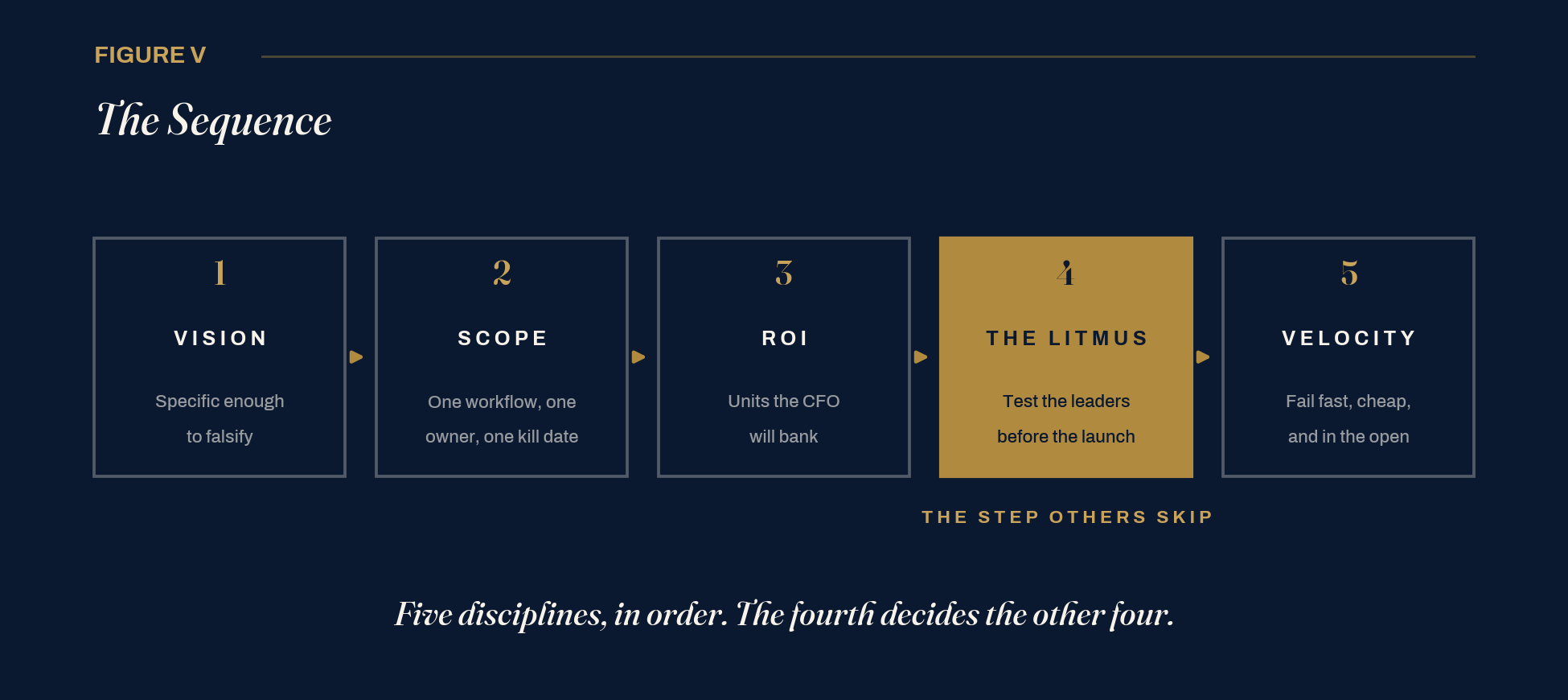
The playbook in order: design disciplines first, then the personnel decision that determines whether the design survives contact with the organization.
None of this requires a larger budget. Most of it requires a smaller one, redirected from the 10 percent everyone funds to the 70 percent everyone ignores.
VI. THE MIRROR
He is in the building.
The line this paper borrows for its title comes from a comic strip. In 1970, cartoonist Walt Kelly drew his possum Pogo for the first Earth Day poster and gave him the caption that opens this paper: we have met the enemy and he is us. The drawing’s power was its refusal to name an external villain. Pogo stands in a forest full of trash and finds no enemy to blame except the one who made the mess.
The AI failure statistics will keep generating headlines, and the headlines will keep implying that the technology has underdelivered. Do not believe it. A technology your own workforce voluntarily uses every day has not underdelivered. What has underdelivered is the layer between that workforce and your strategy: the planning disciplines, the measurement habits, and above all the leaders who met the largest opportunity of their careers with deception, rigidity, or passivity because the alternative was admitting they had become students again.
The companies that cross the divide in the next three years will not be the ones with the best models. Everyone will have the best models. They will be the ones whose CEOs looked hardest at their own teams, ran the test, and acted on the answer. The obstacle is not in the data center. It never was.
Never have we lived in a more exciting time. Mythos, Fable 5…incredible tools that require equally smart leadership and human guidance. Now is the time.
-
REFERENCES
Challapally, A., et al. The GenAI Divide: State of AI in Business 2025. MIT NANDA Initiative, August 2025. Reported in Estrada, S., “MIT report: 95% of generative AI pilots at companies are failing,” Fortune, August 18, 2025.
S&P Global Market Intelligence. AI project abandonment survey of 1,000+ enterprises, North America and Europe, March 2025. Reported in CIO Dive, “AI project failure rates are on the rise,” March 2025.
Gartner. “Gartner Predicts Over 40% of Agentic AI Projects Will Be Canceled by End of 2027.” Press release, June 25, 2025.
RAND Corporation. “The Root Causes of Failure for Artificial Intelligence Projects and How They Can Succeed,” 2024.
Mayer, H., Yee, L., Chui, M., and Roberts, R. Superagency in the Workplace: Empowering People to Unlock AI’s Full Potential at Work. McKinsey & Company, January 2025.
Boston Consulting Group. AI @ Scale practice, the 10-20-70 framework; “AI Adoption in 2024: 74% of Companies Struggle to Achieve and Scale Value,” 2024.
Challapally, A. Interview with Fortune CFO Daily, August 18, 2025.
IBM Institute for Business Value. 2025 CEO Study, survey of 2,000 chief executives across 33 countries, May 2025. One in four AI initiatives delivered expected ROI.
ABOUT THE AUTHOR
Michael Main is the Principal of MJM Strategy Group, an AI-native strategy advisory serving CEOs and senior leaders. He spent 25 years in C-suite consulting at Monitor Deloitte, Accenture, and Oliver Wyman before founding the firm.