
Pong to Protein
How AI’s Learning Curve Can Become Your Enterprise Learning Curve

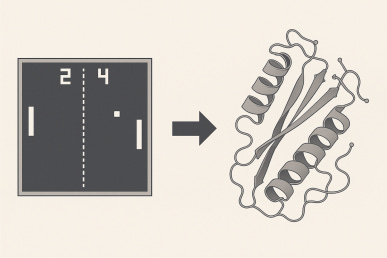
Pong to Proteins – A Model for CEO Led Transformational AI
The most extraordinary thing about the last three years of artificial intelligence is not that the technology improved quickly. What is unprecedented is the compression of intellectual evolution — a shift so rapid, so total, and so unexpected that the human institutions built to manage change haven’t even had time to understand what has happened to them. In 2022, AI was still a novelty. It wrote cute poems, imitated mediocre essays, generated questionable images, and sparked the first uneasy questions about automation. But in hindsight, that moment was the Pong era — the simplest possible demonstration of capability, a toy more than a tool, harmless and almost laughably constrained.
And then, almost instantly, it wasn’t. Pong is where machine learning first proved it could learn. When DeepMind trained a deep neural network to master a primitive table tennis game, the breakthrough was not the game itself—it was the loop: observe, act, receive feedback, correct. That simple loop, repeated millions of times, turned a trivial experiment into a generalizable learning engine.
In six years, the same architecture powered AlphaFold, which solved protein-folding challenges that had eluded scientists for decades. The leap from Pong to proteins is the metaphor leaders need to internalize: small, low-risk experiments, wired into disciplined feedback loops, compound into transformational capability. Every enterprise has its own Pong—a narrow, early use case that reveals the slope of its learning curve. The question for CEOs is no longer if AI will reshape their business, but how intentionally they will climb that curve.
Climbing the curve of data abstraction and generative AI isn’t enough. Culture, leadership, workflows, structure and more must also change. “Moneyball” showed us how humans resist learning. Many executives today can be a lot like the old-school scouts in Moneyball—armed with instincts, experience, and confidence built over decades, but often skeptical of what data and modeling can reveal when it contradicts intuition. For years, business decisions have been made with “a little data and a lot of gut.” Dashboards preserve confirmation bias more than they generate decisions.
Billy Beane’s revolution came from a simple, uncomfortable truth: data sees what judgment cannot, and models see what data alone cannot.
AI is the escalation of that truth.
Leaders who still rely primarily on experience, narrative, and pattern recognition are competing against organizations that run model-driven decision loops—systems that ingest millions of variables, detect weak signals, test thousands of scenarios, and recommend actions in real time. The distance between knowing and knowing better is widening exponentially. First movers achieve a differentially strong advantage.
The right entry point for enterprise AI is not a moonshot; it’s a Moneyball moment. Pick one workflow where intuition consistently falls short: pricing, risk management, supply chain, go to market strategy, staffing, fraud detection or market transparency. This becomes your first AI learning loop—the organizational equivalent of Pong, your proof that systems which learn faster outperform those that simply rely on experience. Cross functional leaders who witness the impact of these first use cases will be clamoring for adoption in their functions.
Moneyball was never just about baseball. It was about breaking with comfortable patterns and having the courage to trust what the data and models show you.
AI requires that same courage, and the same willingness to challenge legacy thinking.
“We cannot solve our problems with the same thinking we used when we created them.” ~Albert Einstein
The leaders who lean into that discomfort will set the pace for their industries. Now is the time to ask new questions and solve new – not yesterday’s problems. Creativity and innovation are at the forefront of that movement.
AI has shifted from novelty to infrastructure. The Wall Street Journal no longer treats AI primarily as a research frontier; instead, it reports on GPU allocation, data-center build outs, capex disclosures, and large-scale deployments. That change in media coverage is diagnostic: AI is becoming a habit of execution, not an experiment. Organizations are no longer buying “AI tools.” They’re buying time:
Time to learn faster than competitors. Time to compress decision cycles. Time to turn weak signals into strong positions
Leaders who see AI as infrastructure—not as an isolated initiative—will accumulate learning and value at a rate that their rivals cannot match. Those who treat AI as a side project will find themselves in the position of pre-Moneyball franchises: proud, experienced, and quietly outcompeted.
As models scale in size, complexity, data diversity, and training sophistication, something strange and profound is happening. Capabilities are not improving linearly.
They haven’t even improved exponentially in the traditional sense. They have jumped categories becoming qualitatively different. AI changed lanes from imitating to understanding, from responding to reasoning, from following instructions to forming its own intermediate steps. It has learned physics intuitively, code structurally, biology probabilistically, and language conceptually. It has learned to use tools, run simulations, plan ahead, and integrate modalities.
It has begun to solve problems that were once considered among the hardest scientific challenges on Earth.
This is why the analogy “Pong to Protein” is so appropriate — it is the most important strategic framing of our era. Pong is trivial. Protein folding is profound. The fact that AI has grasped both within a single architectural lineage is something not even the most optimistic technologists expected. If AI can leap from the shallow end of cognition to the deepest scientific frontiers in a single generational swing, then it is reasonable to assume that the entire gradient of work inside an enterprise will be traversed just as quickly. Every “complex process” that organizations build layers of management around will, in short order, become as trivial to an AI as Pong. The implications for business, industry and society itself will be profound.
This is the point most executives have not yet internalized. They see AI as powerful but still constrained, impressive but not transformative, evolutionary rather than revolutionary.
AI is not becoming “better software.” It is becoming a general reasoning substrate, an intelligence infrastructure capable of absorbing a company’s entire cognitive workload. It doesn’t learn functions — it learns domains. It doesn’t learn instructions — it learns capabilities. It doesn’t automate tasks — it collapses workflows.
The implications are not academic; they are already unfolding in real organizations.
Hypothetical Examples:
Consider a health insurance payer that sets out with the modest goal of improving claims accuracy. What they might discover is that AI did not want to “assist” their administrators—it wanted to become their administrators. It read claims, validated coverage, predicted denial risk, cross-referenced histories, requested additional information, generated EOBs, and updated the ledger autonomously. Supervisors and auditors might then elevate their roles from mundane to solving the hardest problems and bringing enhanced levels of empathy and service to their members. Managers would no longer manage a workflow; they would manage the exceptions to a workflow the AI had learned to run on its own. What had once required layers of human coordination became a seamless biological process. The company would not have digitized its claims department; it would have stumbled into building a new kind of organism. The result would be improved market facing functions, higher customer satisfaction, leaner operations and increased revenue and margin.
A major global retailer intends to use AI to improve demand forecasting. Instead, AI learns every piece of the retail metabolism. It predicts weather effects, adjusts store layouts, optimizes inventory flows, rewrites pricing strategies, recommends promotions, and even redesigns staffing patterns. Corporate offices had built an organization to manage complexity. AI collapses that complexity. What had once felt like a symphony of interacting variables — merchandising, supply chain, pricing, marketing, store ops — becomes a set of solvable equations. The retailer doesn’t “transform.” It mutates into something faster, thinner, more precise, and more intelligent than anything its industry had seen.
Even cities are beginning to visualize this shift. A medium-sized metropolitan area deploys AI to optimize bus routes, hoping for modest cost savings. Instead, AI becomes a citywide operating system. It predicts traffic, rerouts transit dynamically, analyzs crime patterns, optimizes energy usage, monitores infrastructure, recommends staffing levels for emergency services, forecasts floods and outages, and even detects potholes through video feeds. The city council had wanted efficiency. What they got was cognition. The city begins to behave like an organism with a central nervous system — responsive, adaptive, almost alive.
These examples might sound like science fiction — but they are the lenses into the complete reshaping of how we work and live – with enormous transformational power.
What the stories reveal is the same underlying reality: AI’s potential is not maximized living inside your current operating model. Instead, it is capable of reinventing the model in important new ways, helping develop first-mover, strongly competitive differentiation.
How AI is best deployed is the part most leadership teams (and many engineering firms) do not yet understand. They treat AI as a thing to integrate, a tool to adopt, an initiative to launch, a capability to modernize. But AI is not additive. It is subtractive. It removes layers of cognitive friction—layers that organizations were built to manage.
This is why adopting AI without reorganizing the company around it will fail. You cannot bolt an intelligence engine onto a bureaucracy and expect transformation. The bureaucracy must dissolve. This is where Moneyball leadership becomes essential. Billy Beane did not beat baseball by having more talent; he beat baseball by abandoning the narrative that everyone else was loyal to. He trusted uncomfortable truths. He trusted what worked, not what felt right. He trusted data more than tradition. He knew the game had changed, and he was willing to change with it—before anyone else did.
Executives today are standing on the same precipice. The leadership styles that brought them success—intuition, pattern recognition, experience, consensus-building, instinct— are becoming liabilities. In a world of abundant intelligence, intuition becomes the slow variable. Experience decays faster than it compounds. Hierarchy becomes a drag coefficient. Committees become latency. Governance becomes a bottleneck. And the playbook that once worked becomes the most dangerous artifact in the organization.
We must ask, “Who are the CEOs who will lead this change?”
The leaders who will dominate the next decade are those who embrace this truth and grasp this fundamental reality shift. They will understand that the role of the CEO has shifted from the conductor of human labor to the architect of intelligence metabolism. Their job is no longer to synthesize incomplete information; AI will do that. Their job is no longer to cascade decisions through layers of management; AI will bypass those layers.
The CEO’s new job is to redesign the company into something that can absorb and make use of intelligence at the speed it is produced.
This is a radically different kind of leadership. It demands courage, clarity, dismantling, rebuilding, and an almost ruthless willingness to abandon the organizational comfort of the past. It demands that the CEO become the Billy Beane of their industry—tapping into the undervalued signals, exploiting the inefficiencies everyone else ignores, and acting decisively before rivals even understand what has happened.
The most important strategic truth of our time is this: AI is improving faster than your organization.
Faster than your processes, your governance, your budgeting cycles, your hiring practices, your training programs, your compliance systems, your innovation cadence, and your leadership instincts. The gap between technological capability and organizational adaptability is widening. Only those who transform themselves will survive the widening and reap its rewards.
The leap from Pong to Protein is not just a metaphor. It is a countdown. It tells us how fast intelligence can evolve. It tells us how quickly complexity can collapse. It tells us how vulnerable every institution is to a technology that learns faster than they do. And most importantly, it tells us that the companies that will matter in the next decade are those whose leaders recognize one thing before everyone else:
The game has changed—and the old one is on the verge of being over. And, there simply isn’t a more exciting time to be alive.