
Exponential AI Possibility to Reality Now
A Human-First AI Playbook for Healthcare CEOs Who Are Ready to Lead

Update - June 2026: This briefing first ran in February, and everything below has only accelerated since. The labs have moved several model generations forward - Anthropic alone has shipped Opus 4.7 and 4.8 and, in June, its first model in an entirely new tier above Opus.
The Moment We're In:
The AI industry had one of its most consequential weeks ever, and it wasn’t just about safety concerns. It was about the simultaneous acceleration of capability and erosion of guardrails happening at the same time.
On the capability side: Anthropic launched autonomous agent teams - AI systems that coordinate with each other to complete complex projects. OpenAI launched its Codex desktop application, with over a million developers already using it. The WSJ podcast “The Journal” reported on OpenClaw, a powerful agentic creator, and Moltbook, a social media platform where AI bots are talking to other bots about religion, secret languages, and a “Bots Bill of Rights.” And Wall Street noticed: software stocks lost roughly $300 billion in market cap in a single week - the “SaaSpocalypse” - as investors priced in the reality that AI agents are replacing the humans who use enterprise software, not just the software itself.
▶ Listen: WSJ “The Journal”: AI Bots Have Social Media Now
On the safety side: Senior safety researchers exited OpenAI, Anthropic, and xAI simultaneously. Safety teams were dissolved. Anthropic’s safeguards lead resigned, warning the world is in peril. Half of xAI’s founding team is gone.
This is the duality CEOs must understand: AI is getting dramatically more powerful AND the people building guardrails are leaving. Both things are true. Organizations that freeze lose. The ones that lead with eyes open and governance in place win.
Acceleration: Autonomous agent teams went mainstream. OpenAI Codex desktop app launched. AI bots now have their own social networks.
Market impact: $300B wiped from software stocks in one week. Salesforce −26%, ServiceNow −28% across early 2026.
Safety shifts: OpenAI safety team dissolved and policy VP fired. Anthropic’s safeguards lead resigned. xAI - 6 of 12 founders now gone.
The Leadership Reframe
Concerns around safety and keeping pace with the blinding speed of development are real - and they’re exactly why your organization needs to lead, not wait. CEOs who build governance, invest in their people, and move with purpose will define this era. Those who outsource AI strategy to vendors or hesitate will be left behind.
The AI researcher exodus is a signal, not a verdict. It tells us that commercial pressure is overriding safety at the labs, that self-regulation has gaps, and that external regulation is years away. But for a healthcare CEO, these aren’t reasons to pause. They’re reasons to build your own governance, your own safety framework, and your own AI strategy - on your terms.
The organizations that self-govern now will be ahead when regulations arrive. The ones that build governance first will move faster with confidence, because the right guardrails don’t slow you down. They give your teams the confidence to act boldly.
The End Game: AI-Native Healthcare
Here’s where this is heading, and every CEO needs to internalize it: AI-native doesn’t mean adding AI tools to your existing structure. It means reconstituting your business model entirely.
Departments that exist because humans couldn’t share information fast enough will collapse into unified, AI-enabled workflows. Data silos that required entire teams to bridge will dissolve. Bureaucratic layers that existed to coordinate across functions will be replaced by systems that coordinate in real time.
This is not about eliminating people. It’s about elevating them. When AI handles coordination, data synthesis, and routine decisions, your people are freed to exercise judgment, build relationships, innovate, and lead.
AI-native means:
Collapsing departments that exist only because of data silos
Eliminating bureaucracy that slows decisions
Rethinking strategy around speed + quality
Redesigning culture for human-AI collaboration
Creating new roles that generate more value than the ones they replace
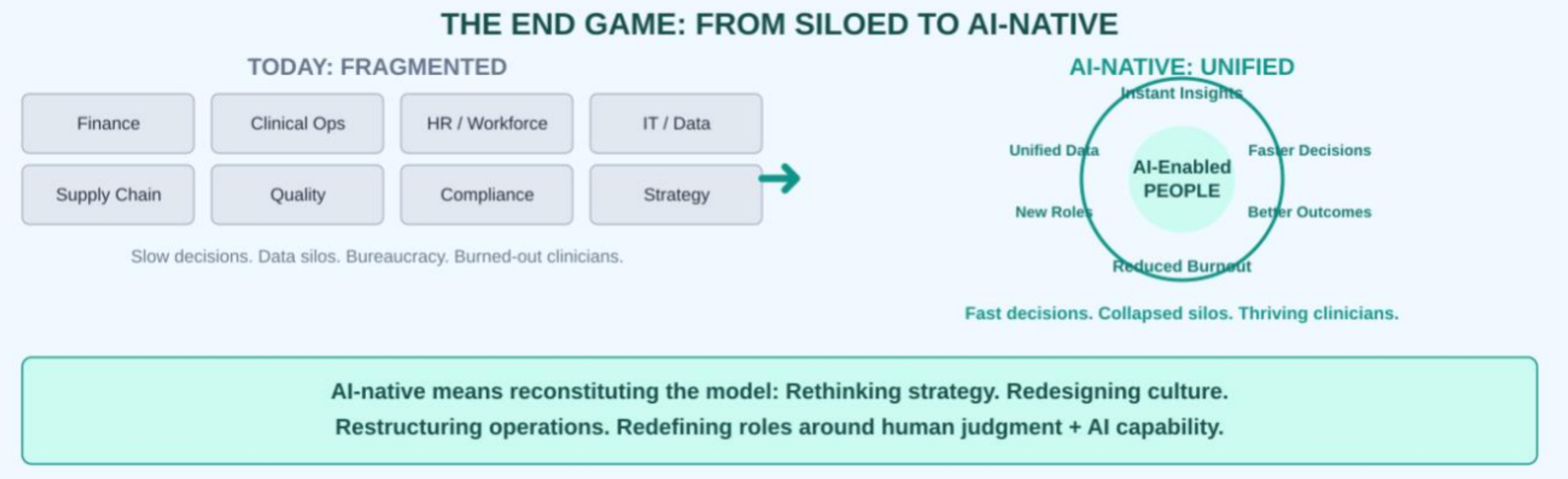
The shift is from today’s fragmented model — Finance, Clinical Ops, HR, IT, Supply Chain, Quality, Compliance, and Strategy all siloed, producing slow decisions, data silos, bureaucracy, and burned-out clinicians — to an AI-native unified model, where AI-enabled people sit at the center of instant insights, unified data, faster decisions, new roles, better outcomes, and reduced burnout. Fast decisions. Collapsed silos. Thriving clinicians.
AI-native means reconstituting the model: rethinking strategy, redesigning culture, restructuring operations, and redefining roles around human judgment + AI capability.
The AI Journey: Faster Than You Think
Consider the acceleration:
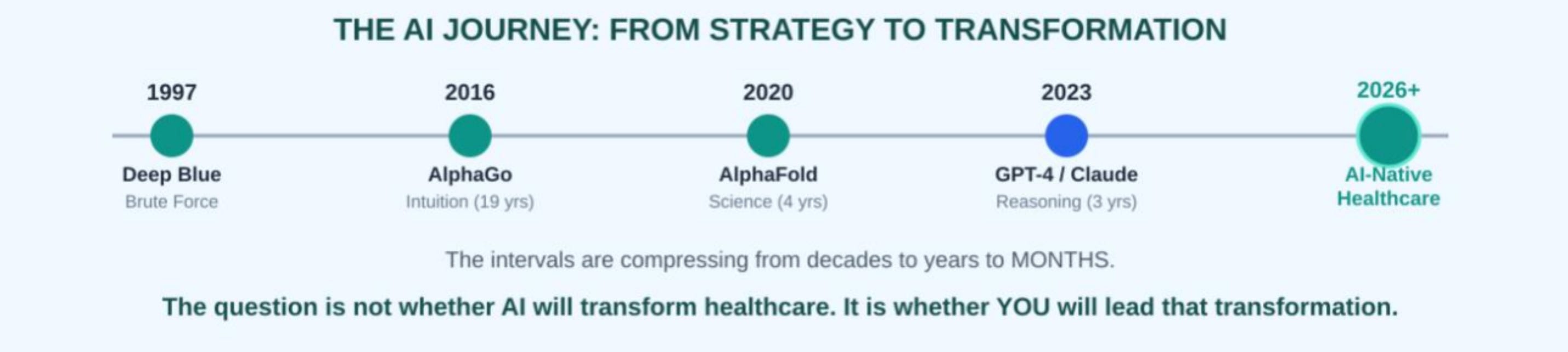
It took 19 years to get from Deep Blue to AlphaGo. 4 years from AlphaGo to AlphaFold’s breakthrough. 3 years from AlphaFold to GPT-4. And now, autonomous AI agents are writing code, conducting research, and making complex decisions — while $300 billion in software value evaporated in a single week.
Each capability leap happened faster than the last. The governance, safety, and organizational structures around AI have not kept pace. That gap is real. But it’s also an opportunity, because the organizations that build governance now, while others hesitate, will have an enormous competitive advantage.
The intervals are compressing from decades to years to months. The question is not whether AI will transform healthcare. It is whether you will lead that transformation.
The speed imperative: Demis Hassabis, CEO of Google DeepMind and Nobel laureate, says AI will be “10 times bigger than the Industrial Revolution, and maybe 10 times faster.” The change is exponential. Waiting is not caution. Waiting is risk.
The Provider Labor Crisis Is Your AI Opportunity
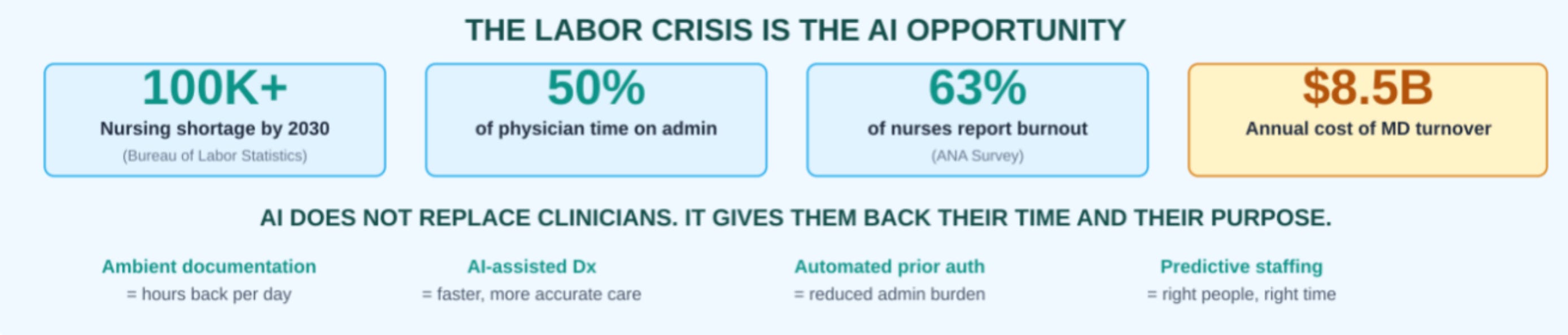
Healthcare’s workforce crisis is a present emergency. Physicians spend roughly half their time on administrative tasks. Nurses are burning out at record rates. The talent pipeline cannot fill the gap at current trajectories.
This is where AI changes the equation - not by replacing clinicians, but by giving them back their time, their focus, and their sense of purpose:
Ambient documentation returns hours to a physician’s day
AI-assisted diagnostics improve speed and accuracy
Automated prior authorization eliminates one of medicine’s most soul-crushing burdens
Predictive staffing puts the right people in the right place at the right time
Every hour AI gives back to a clinician is an hour returned to patient care, teaching, or innovation. That’s not a technology story. That’s a human story.
People first, always. AI doesn’t replace your best nurse. It takes the charting off her plate so she can be with the patient who’s scared. It takes the prior auth off the physician’s desk so she can spend 10 more minutes with the family. That’s the promise. Lead with it.
The Payer Imperative
Payers face a unique convergence of pressure. Regulatory scrutiny is intensifying. CMS is actively developing frameworks for AI in coverage determinations, and the EU AI Act will impose new transparency requirements by late 2026. Members expect faster decisions. Employers demand lower administrative costs.
AI is already making coverage determinations, processing claims, detecting fraud, and triaging appeals. The question for payer CEOs is not whether AI is in your operations - it is. The question is whether you’re governing it proactively or waiting for a regulator to tell you it’s wrong.
The payers that win will use AI to: dramatically reduce claims processing time while improving accuracy; automate prior authorization; deploy predictive analytics for population health that actually reduces total cost of care; build transparent, auditable AI decision-making that withstands regulatory review; and reduce reliance on expensive SaaS licensing models by replacing point solutions with AI-native workflows that do the work those platforms once required humans to perform.
The competitive advantage is enormous. A payer that can process a clean claim in nanoseconds instead of days, resolve a prior auth in minutes instead of weeks, proactively identify high-risk members before they hit the ED, and run real-time predictive modeling and advanced scenario planning across its entire book of business will attract employers, retain members, and outperform on MLR. Go-to-market strategies that sought total market transparency - from employer, to broker or consultant, to plan design and renewal dates - will be readily available and mapped to market coverage models, networks, and marketing plans. Proactive sales strategies will revolutionize the “wait for the RFP” approaches of the past. Progressive payers will unify their leadership teams around market and organizational transparency, elevating their performance to previously impossible levels. Differentiation will be BIG.
Payer CEO checklist:
Audit AI in claims, PA, and utilization management
Build regulatory-ready AI governance now
Invest in AI-powered member experience
Reduce administrative friction for providers
Scenario-plan for CMS AI oversight rules
Position for competitive advantage, not just compliance
Recognize that go-to-market strategies will increase in velocity with surgical precision
Where It’s Working: The Most Powerful Use Cases
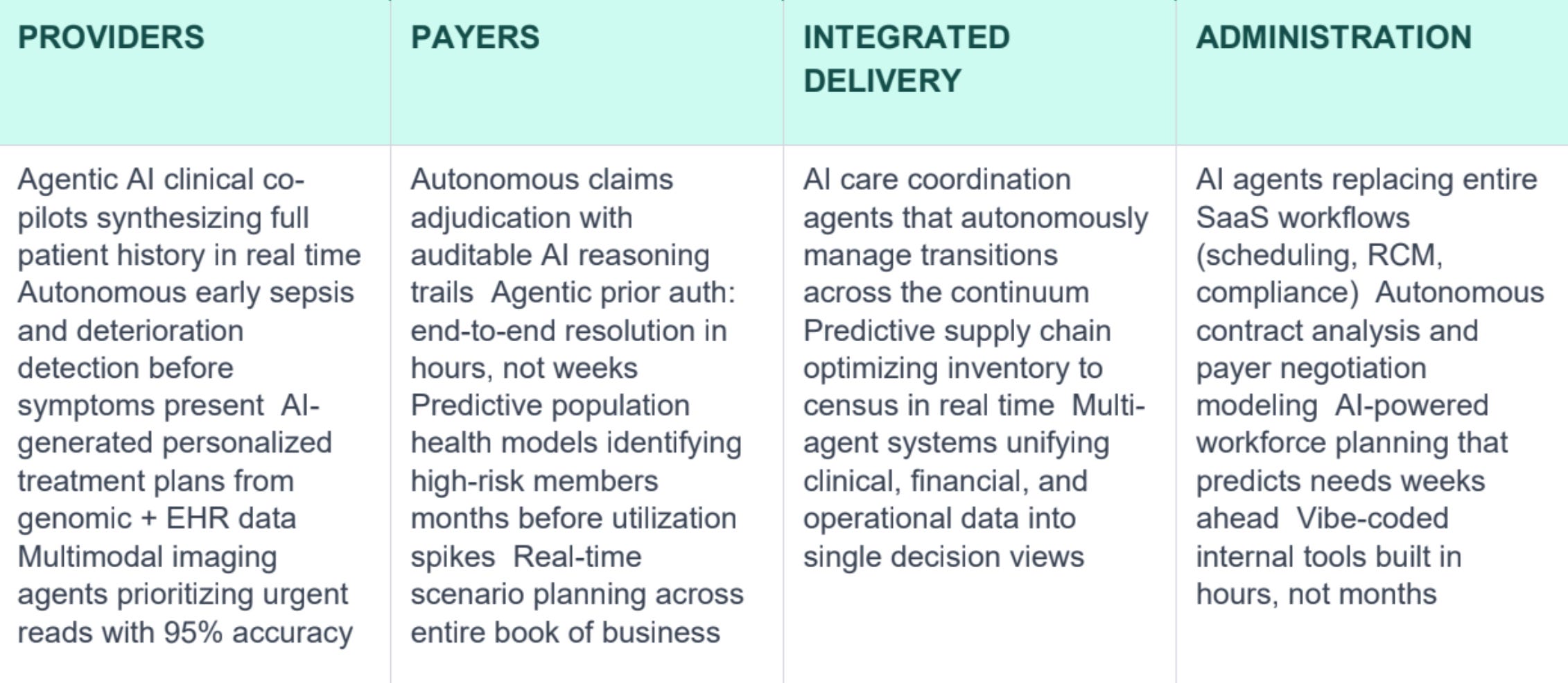
The CEO’s New Job
The role of the healthcare CEO is being redefined by AI, not replaced by it. The CEOs who thrive in this era will do seven things differently:
Paint the AI-native vision. Articulate a clear picture of what AI-native healthcare looks like for your specific organization, and communicate it relentlessly.
Build conviction, not consensus. You will not get 100% buy-in before you start. Lead with conviction. Show early wins. Let results build momentum.
Sequence the transformation. Start where the pain is highest and the risk is lowest. Let people feel empowered rather than threatened.
Own the governance. AI governance is not an IT function. It is a CEO function. The board, the medical staff, and the regulators will hold you accountable. Get ahead of it.
Build the culture deliberately. AI transformation fails without cultural transformation. Create psychological safety to experiment. Reward curiosity. Make AI fluency a leadership competency, not an IT initiative.
Invest in people first. Retrain, reskill, and elevate your workforce. The organizations that treat AI as a way to create better jobs — not just fewer jobs — will attract and retain the best talent in a market that desperately needs it.
Take the wheel of the AI and drive your vision more swiftly and clearly through the organization. New tools are breeding a new type of executive — the CEO who accelerates research, decision quality, and speed to execution, thereby driving leadership teams to new performance frontiers.
“Can you have entire companies where the founder does everything because what the founder is doing is overseeing an army of AI bots?” — Marc Andreessen, a16z, Jan 2026
New roles > old roles. Rather than eliminate, shift entire employee populations to high-value, market-facing roles. Human-first will differentiate from the automated organization. The new roles emerging include:
AI clinical liaisons
Model governance leads
Human-AI workflow designers
AI ethics officers
Data trust architects
AI-enabled care coordinators
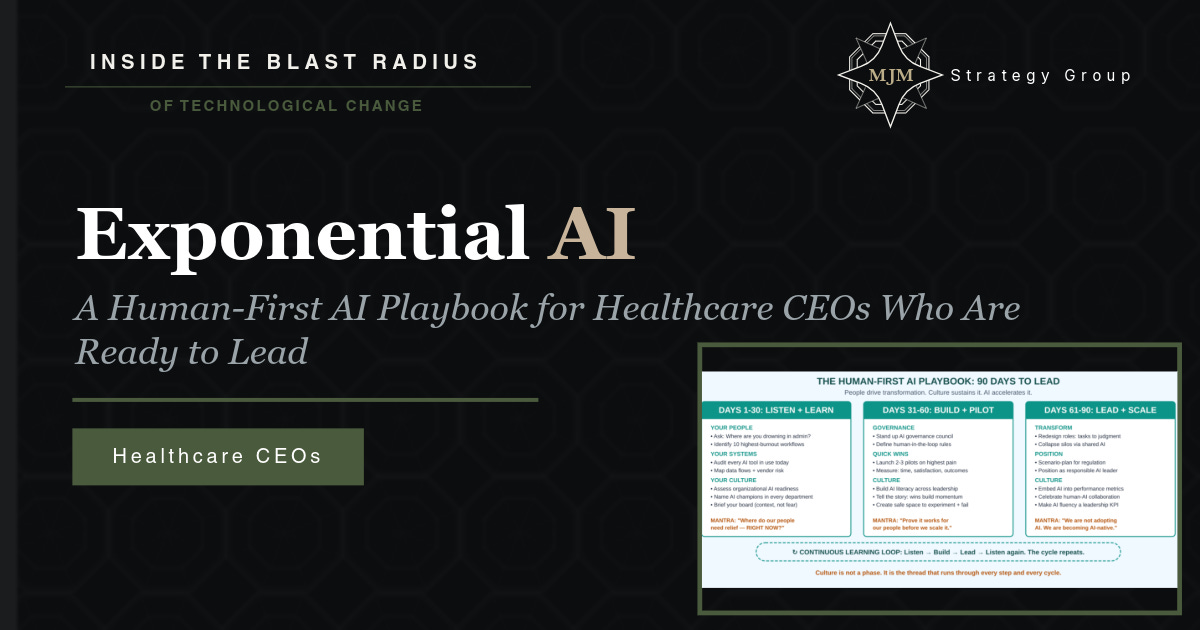
Your Human-First AI Playbook
People drive transformation. AI accelerates it. Here is your 90-day plan to lead with both.
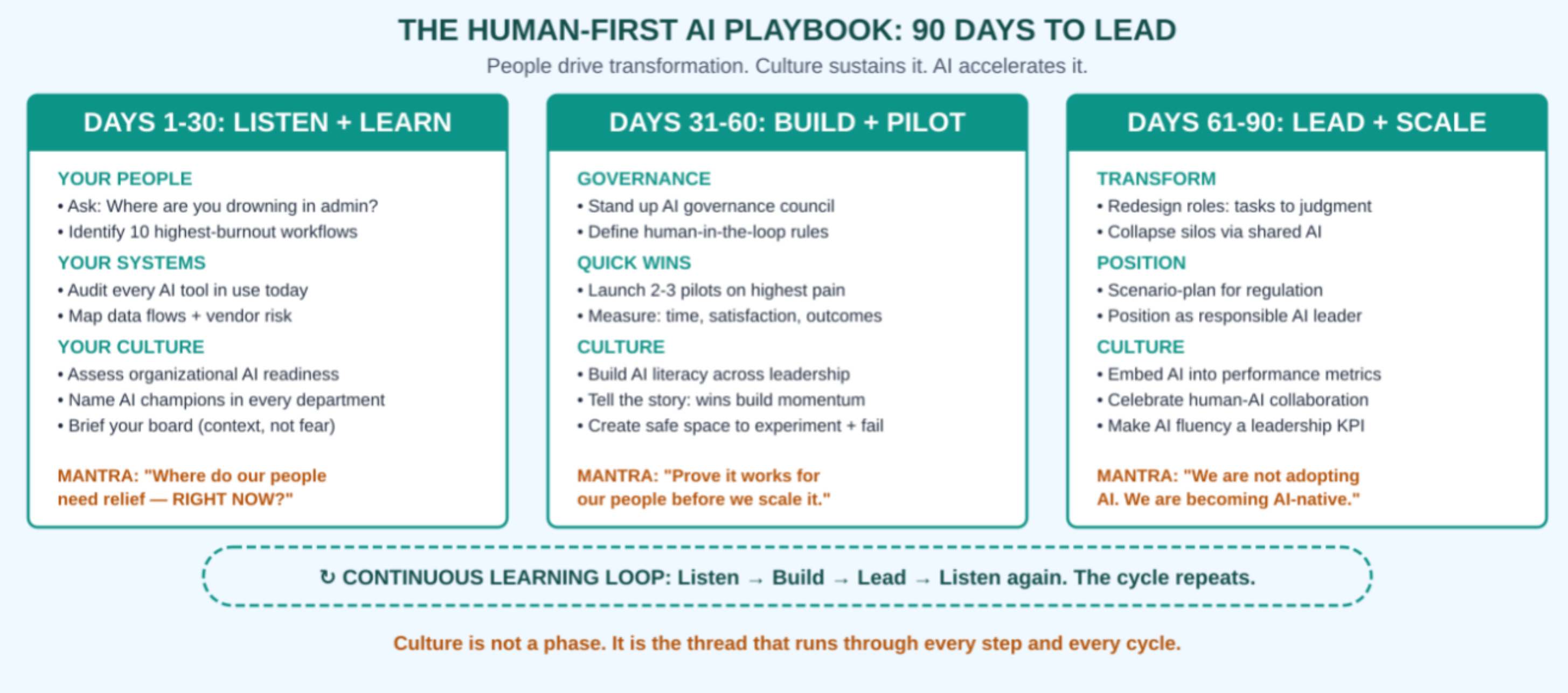
Days 1–30: Listen + Learn
Your people: Ask where you’re drowning in admin. Identify the 10 highest-burnout workflows.
Your systems: Audit every AI tool in use today. Map data flows + vendor risk.
Your culture: Assess organizational AI readiness. Name AI champions in every department. Brief your board (context, not fear).
Mantra: “Where do our people need relief - RIGHT NOW?”
Days 31–60: Build + Pilot
Governance: Stand up an AI governance council. Define human-in-the-loop rules.
Quick wins: Launch 2–3 pilots on highest pain. Measure time, satisfaction, outcomes.
Culture: Build AI literacy across leadership. Tell the story - wins build momentum. Create safe space to experiment and fail.
Mantra: “Prove it works for our people before we scale it.”
Days 61–90: Lead + Scale
Transform: Redesign roles - tasks to judgment. Collapse silos via shared AI.
Position: Scenario-plan for regulation. Position as a responsible AI leader.
Culture: Embed AI into performance metrics. Celebrate human-AI collaboration. Make AI fluency a leadership KPI.
Mantra: “We are not adopting AI. We are becoming AI-native.”
The cycle repeats: Listen → Build → Lead → Listen again. Culture is not a phase. It is the thread that runs through every step and every cycle.
The leadership test: In 90 days, you will either have a clear AI vision, a governance structure, and early wins that prove the model works - or you’ll be watching your competitors build them. The window is open. Walk through it.
The bottom line: Lead with people. Accelerate with AI.
There is simply no more exciting time to be alive and leading an organization. The AI landscape is changing weekly. The leaders who move with clarity, conviction, and care for their people will be the ones who define healthcare’s next chapter.
The time is now.