
Engineering Health
We must step back from the precipice of an imploding system. The math and tools are finally in our favor and this is why takers of risk will recapture and recapitalize the market.

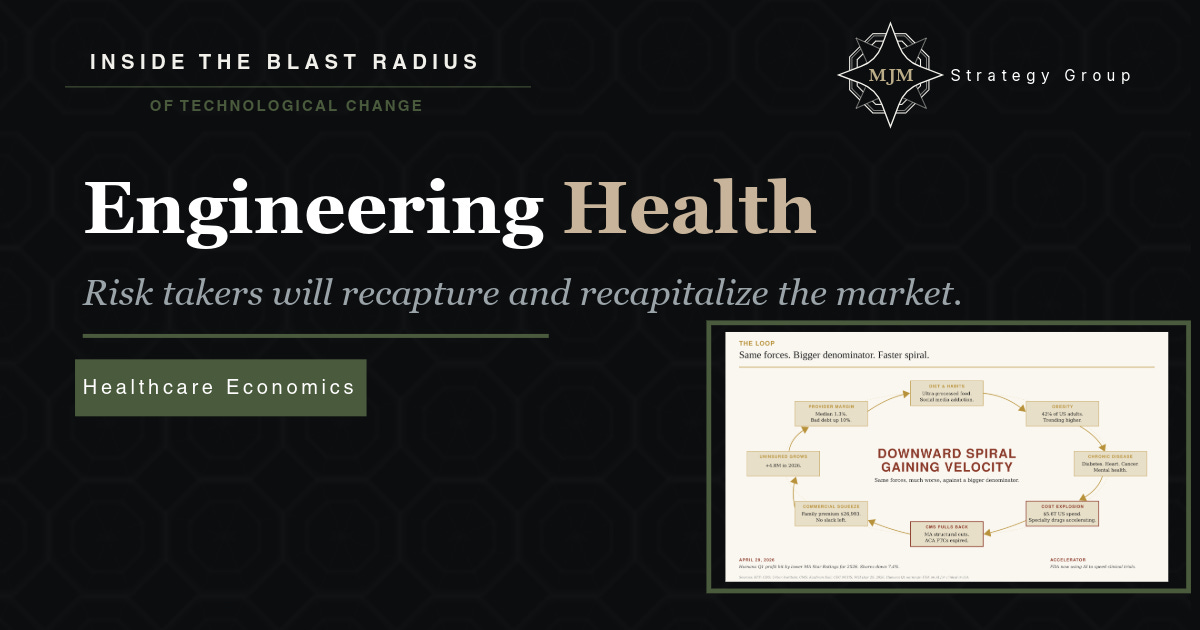
The downward spiral is gaining velocity
The diagnosis is not new. American eats poorly, drinks too much, smokes still too often, sleeps too little, and stares too long. The food industry engineered the appetite. The attention industry engineered the reward circuit. Diet and habit deteriorate. Disease follows.
Cost follows the disease.
The system absorbs the cost.
We have been writing this paragraph for a generation.
What is new in 2026 is the size of the denominator and the speed of the spiral. US health spending crossed $5.6 trillion. Government, the buyer that absorbed the worst of the cost in past decades, is pulling back at the same time the consumer cushion is gone.
AI-driven specialty drug discovery is preparing to deliver another wave of high-cost therapies into a system that cannot price them, and the FDA itself just announced it will use AI to accelerate clinical trial review. The next wave lands sooner than the previous baseline assumed. Same forces, much worse, against a much larger denominator, with the next acceleration already on the runway.
The spiral is not gaining velocity in some abstract future. It is gaining velocity now.
The squeeze is concrete:
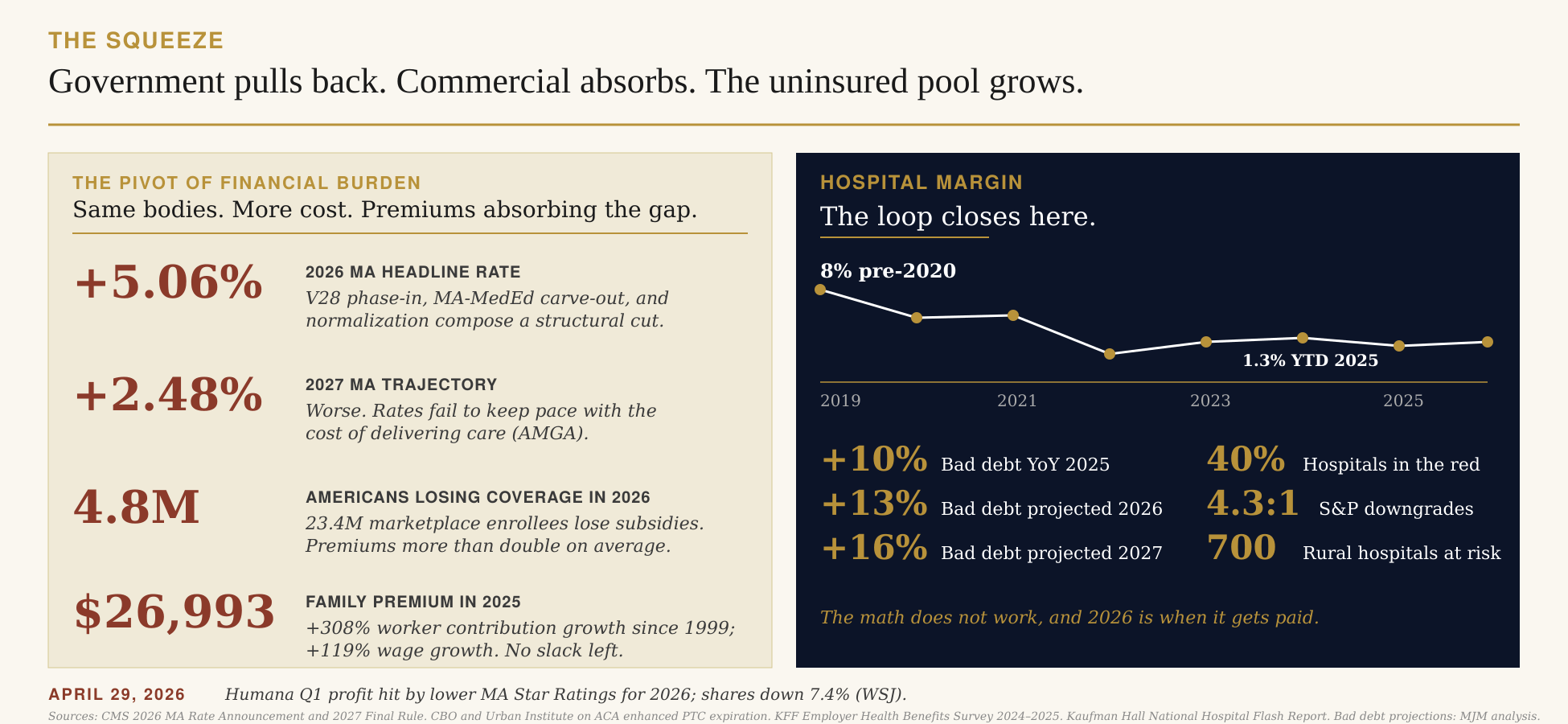
The pivot of financial burden is the part the headline rate notice misses. Medicare Advantage finalized at +5.06% for 2026, which sounds like a lift, but the V28 risk model phase-in, the MA-related medical education carve-out, and the normalization adjustment compose a structural cut underneath the headline.
AMGA’s reading is direct: the rates fail to keep pace with the cost of delivering care. The 2027 trajectory, finalized at +2.48%, is worse. The numbers reach earnings calls quickly. On April 29, 2026, Humana reported lower first-quarter profit on lower 2026 Star Ratings, and the stock dropped 7.4% in pre-market. ACA
Exchange enhanced premium tax credits expired at the end of 2025; 23.4 million marketplace enrollees lose subsidies that have been shielding them since 2021, premium payments more than double on average, and the Urban Institute models 4.8 million Americans falling out of coverage in 2026 alone. Medicaid is tightening on a parallel track.
Government cuts shift directly to commercial contracts. We’ve seen this phenomenon before and employers and their employees will bear the cost.
Family premiums hit $26,993 in 2025 against worker contribution growth of 308% and wage growth of 119% since 1999. There is no slack left in that line.
And specialty drugs are about to accelerate again. AI-driven discovery is compressing development cycles, the FDA is using AI to streamline clinical trial review, and the next wave of high-cost biologics and targeted therapies will arrive at exactly the moment the commercial column has the least capacity to absorb them.
The loop closes on the providers. Hospital median operating margin sits at 1.3% YTD 2025 with allocations. Bad debt is up 10% year over year in 2025 and projected to climb through 2027. Forty percent of hospitals are operating in the red. Seven hundred rural hospitals are at risk of closure. S&P is downgrading hospitals 4.3 times for every upgrade. The math does not work, and the next 24 months are when the situation gets dramatically worse.
Twenty years of value-based care, and the line refuses to bend
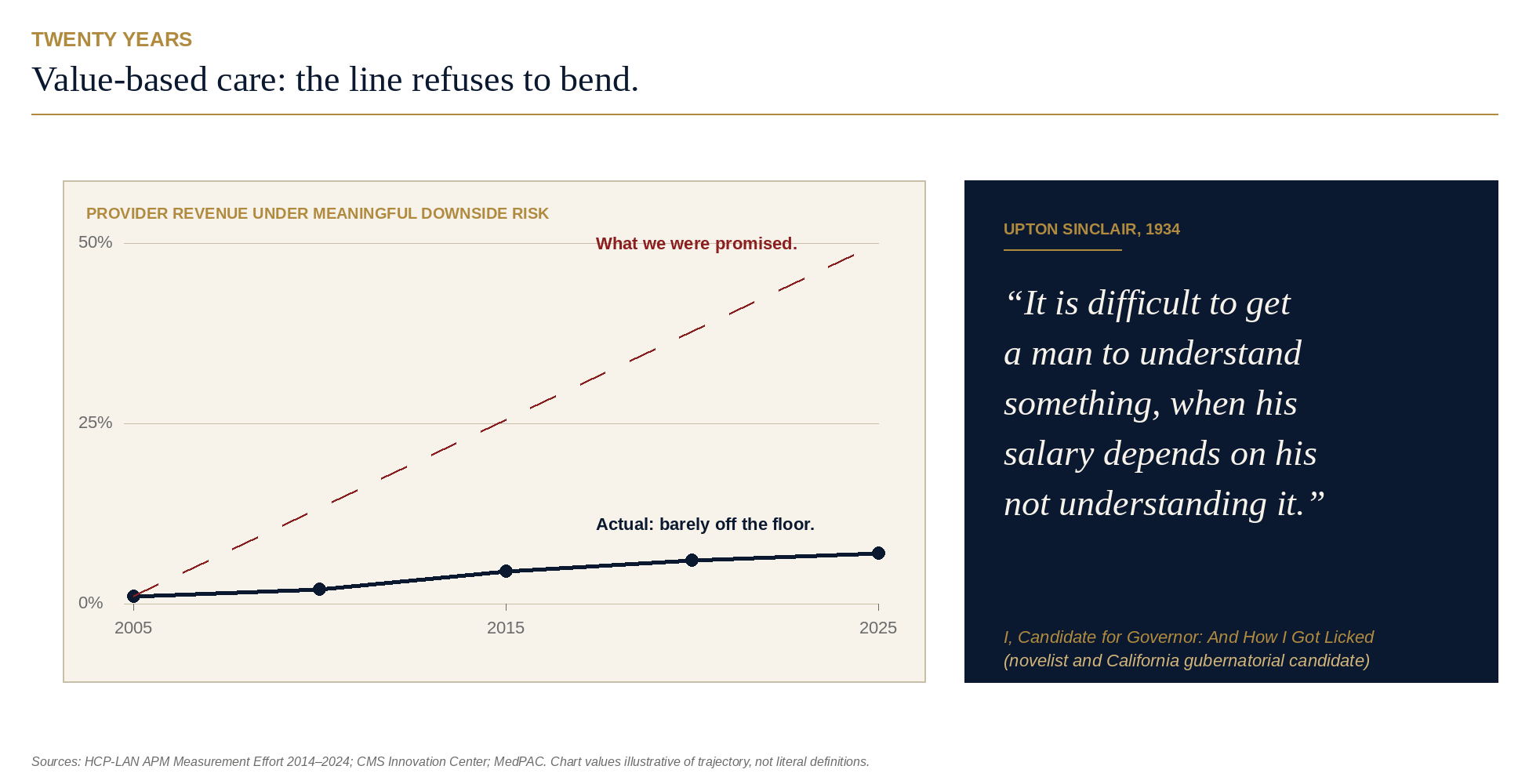
I have spent a long time inside this work. I have consulted payers and providers toward value-based arrangements for two decades. The answer was always the same. Move from volume to value. Take risk. Get paid for outcomes. The logic is correct. The line refuses to bend.
The reason is not analytic. It is structural. A provider whose revenue depends on a fee schedule has a financial interest in the fee schedule continuing. A specialty group whose volume depends on procedures has an interest in the procedures continuing. A hospital whose admissions sustain its fixed cost base has an interest in the admissions continuing. None of these actors is a villain.
A physician and board member of a strong regional health plan said, “Wait, you aren’t talking about reducing my revenue are you?” in response to a VBC presentation I was giving to the plan’s board illustrating how the new VBC system could reduce the total cost of care by 30%
Each is responding rationally to a payment structure that pays them to do exactly what they do. Upton Sinclair, the author of The Jungle, said it best in the same year he ran for governor of California, “It is difficult to get a man to understand something, when his salary depends on his not understanding it”. Every CMMI demonstration, every MSSP cohort, every risk corridor, every ACO ramp has run into the same wall. The constituents’ financial situations depend on not understanding.
Twenty plus years on, provider revenue under meaningful downside risk sits at high single digits. The line is barely off the floor. The promise was different and the results are becoming catastrophic.
AI changes unit economics
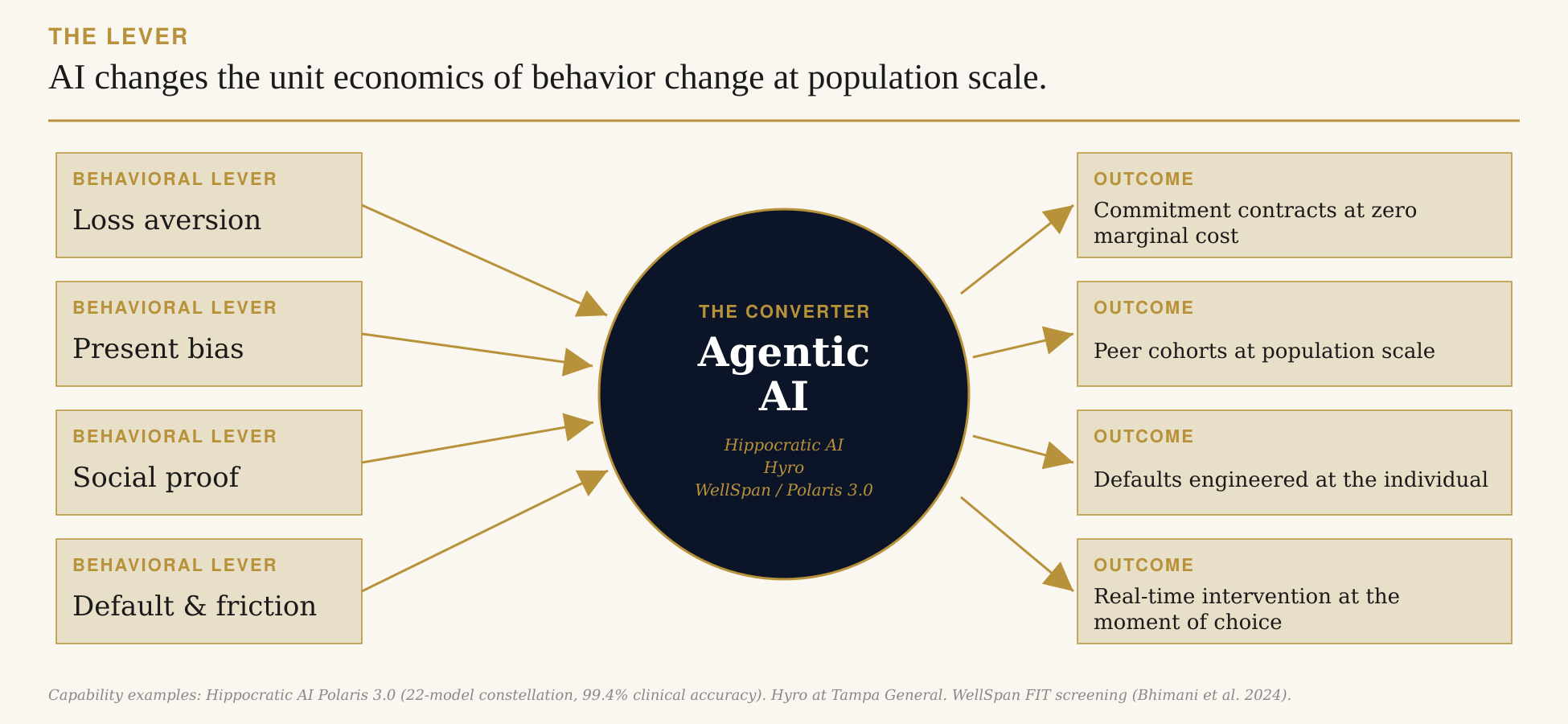
One lever VBC always needed and would have benefited from is consumer behavior change at population scale. Behavioral economics has known the mechanisms for forty years. Loss aversion. Present bias. Social proof. Habit formation. Default architecture. Friction. The literature is mature. The deployment has been hand-built, expensive, and small. Given increasing time pressure on providers, this level of attention wasn’t possible.
Agentic AI changes the unit economics. A commitment contract that took a Penn research team months to design and administer for two thousand CVS Caremark employees can now be constructed, held, and dynamically renegotiated for every interested member of a covered population at marginal cost approaching zero. A peer cohort that depended on physical proximity and human facilitation can be matched on similarity at network scale and sustained continuously. A default that was set at the system level can be engineered at the individual level. A friction reduction that required a human at the point of decision can run in real time through voice, text, and ambient interfaces. Hippocratic AI’s deployed Polaris 3.0 stack runs 22 specialized models at 99.4% clinical accuracy and contacted 100,000 patients in a single day during a Florida hurricane. Hyro’s deployment at Tampa General produced 21% more scheduled appointments, 56% lower call abandonment, and 58% shorter wait times within two weeks. WellSpan’s multilingual screening agent inverted the long-standing FIT test disparity between Spanish and English speakers in a single deployment.
Some providers, payers and consumers will push back and point to what isn’t perfect. Their arguments and perspectives will be legitimate but possibly short sighted.
A Chief Medical Officer said, “If we make self-driving illegal because of one Tesla fatality, when 50,000 motorists are killed driving themselves per year, we are throwing the baby out with the bathwater.”
The point is not that any one of these capabilities is exotic, rather the lack of adoption and economic interest is slowing what is possible. Stacking and deploying all six behavioral levers together, individualized to every member, sustained continuously, at population scale, did not exist a year ago. It exists now. It is what closes the gap between behavioral economics theory and behavioral economics outcomes. Tied to economic incentives, they become an powerful tool in the VBC arsenal.
The three-pillar attack and the arbitrage
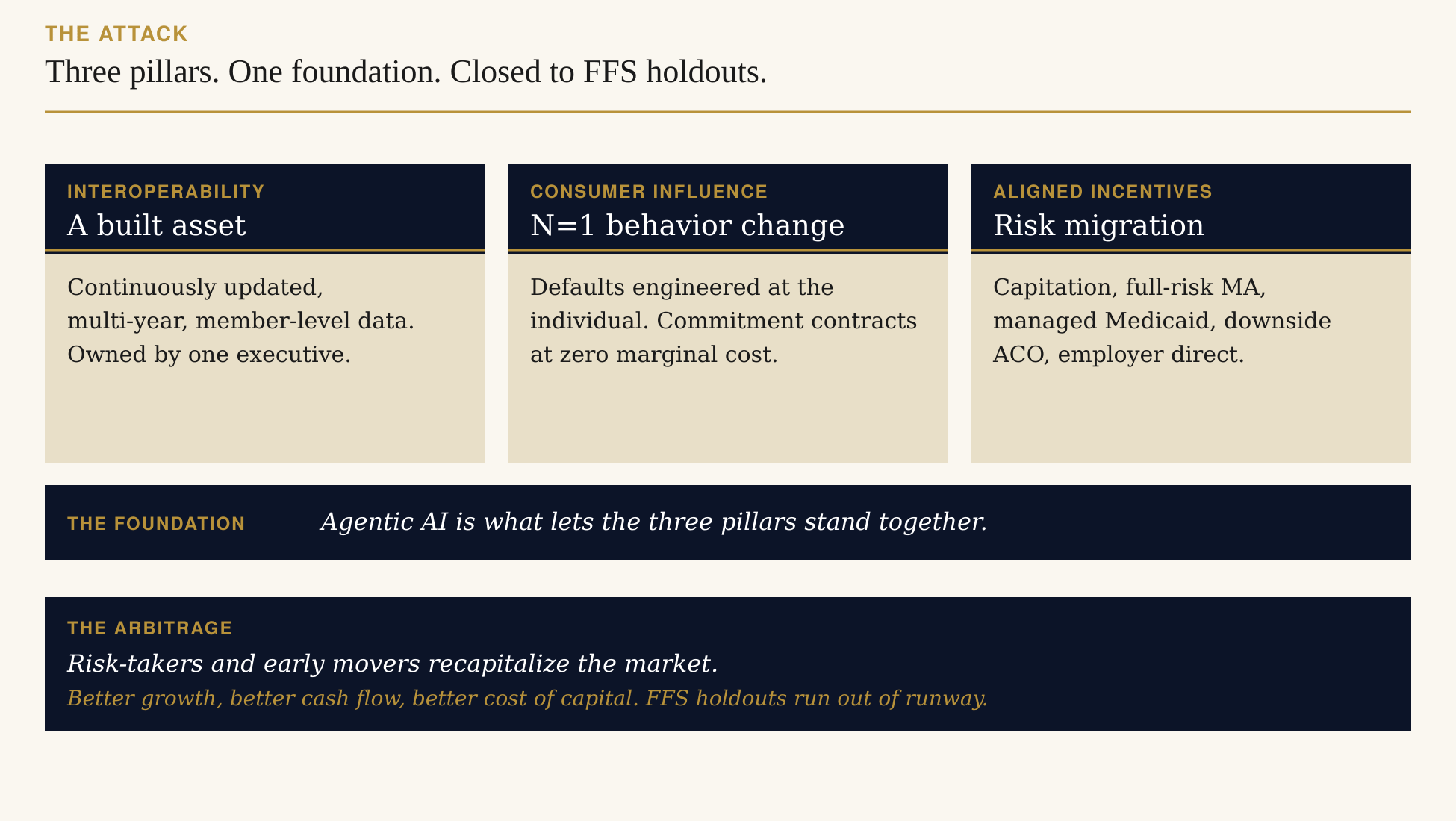
Three pillars, executed together, made possible by the AI stack underneath. Interoperability is the data substrate that lets every other move run on a current, member-level picture. Consumer influence is the agentic layer that engineers behavior at N=1. Aligned incentives is the migration of revenue from fee-for-service to capitation, full-risk MA, managed Medicaid, downside-risk ACO, direct contracting, and employer direct. None of the three works without the other two. AI is the connective tissue that finally lets all three operate as a single system.
The arbitrage is the part that should get a CEO excited. Risk-takers and early movers recapitalize the market. They grow faster because consumer engagement actually shifts. They generate stronger cash flow because behavior change finally bends the cost curve they have been buying. They lower their cost of capital because rating agencies reward demonstrable margin durability. Meanwhile, the FFS holdouts run out of runway. Their top and bottom lines are shrinking under the squeeze. Their payer mix is deteriorating. Their bad debt is rising. Increasingly they cannot defend the margins they once took for granted. The window for the move is now and it is finite.
Closing
This paper sits next to “Code Blue” by MJM Strategy Group. Code Blue opened the conversation about what AI could do for healthcare. Engineering Health answers the specific question of how AI solves the consumer behavior change problem that twenty years of value-based care has been unable to solve. The same forces that have been killing us are accelerating. The cushion is gone. The line did not bend. The lever is here. The risk-takers will recapitalize.
Agentic AI and recursive learning is here, who will leverage to finally address the crisis?