
Code Blue
Artificial Intelligence as a Viable Path to Saving American Healthcare


EXECUTIVE SUMMARY
Healthcare leaders are more challenged than ever before, and more enabled to solve the industry’s crisis than at any time in history, if they can embrace radical change.
The United States spends $5.3 trillion a year on healthcare, 18% of GDP, inflating at 5.8% annually. CMS projects $8.6 trillion by 2033, and on that trajectory, spending will surpass $10 trillion before 2040. The country spends more than twice as much per person as comparable nations and produces worse mortality outcomes, driven in part by a chronic disease epidemic, an opioid crisis, and systemic disparities in access that no other wealthy country tolerates. This spending trajectory is on a collision course with economic reality, and it is contributing directly to the disproportionate distribution of care across the country. Unequal access to care is further exacerbated by a labor shortage that will confound access, cost, and quality simultaneously.
Artificial Intelligence changes this trajectory. Organizations that deploy AI at scale can improve their cost structures, expand capacity without proportional headcount, capture performance based revenue, and attract clinical talent that increasingly flows toward technology-enabled environments. Organizations that treat AI as an IT initiative, or defer it pending further evidence, risk margin compression, workforce attrition, and decreased competitive relevance. Delay is a decision, and it carries financial consequences.
“Healthcare has a more severe labor shortage than any other field. The industry is expected to be short 10 million workers by the end of the decade. The ability for AI to reason, plan and act is foundational to how we’re going to go forward.”
— Jensen Huang, CEO, NVIDIA (JP Morgan Healthcare Conference, Jan 2025)
Countries with less entrenched healthcare orthodoxies are already moving faster. China deploys AI diagnostics at population scale. India and the Gulf states build AI-first infrastructure from the ground up. The UK published a comprehensive national AI strategy for the NHS with specific investment commitments, procurement frameworks, and curriculum reform timelines. The U.S. invented most of these technologies. Without decisive action, it may be among the last to deploy them at scale. That should alarm every health system CEO in America.
UK NHS AI STRATEGY
Goal: “The most AI-enabled health system in the world”
• 5 transformative technologies: data, AI, genomics, wearables, robotics
• £113M+ invested in 80+ AI innovations to date
• 3% of annual spend mandated for transformation
• £180M AI procurement framework for diagnostics
• Medical curricula overhaul within 3 years • National regulatory commission for healthcare AI
NHS 10-Year Health Plan, July 2025
AI changes the fundamental calculus of healthcare delivery. It augments clinical capacity. It automates administrative waste. It enables performance-based payment models that have struggled to be financially viable without real-time analytics. It extends access through virtual and AI-mediated tools that can reach patients who have historically lacked access to specialist expertise. These capabilities are available today, in production, generating measurable returns. And, we are only at the starting line.
“The greatest opportunity offered by AI is not reducing errors or workloads, or even curing cancer: it is the opportunity to restore the precious and time-honored connection and trust, the human touch, between patients and doctors.”
— Dr. Eric Topol, Scripps Research Translational Institute
This paper makes a direct argument: AI is the most promising viable path to repairing a broken healthcare system at risk of further decline. Organizations that deploy it will fulfill their missions of caring for their communities and improving the health of their populations while building durable financial advantage. This paper explains why, how, and how fast.
I. The Crisis in 60 Seconds
The American healthcare system is running out of people to deliver care, access is becoming more constrained and costs are out of control. The math is straightforward, demand is surging while supply contracts, and every traditional lever has been pulled without closing the gap. Cost, quality and increasingly access are disproportionately imbalanced.
“Our health-care morass is like the problems of global warming and the national debt, the kind of vast policy failure that is far easier to get into than to get out of.”
— Dr. Atul Gawande, Surgeon, Author, Harvard
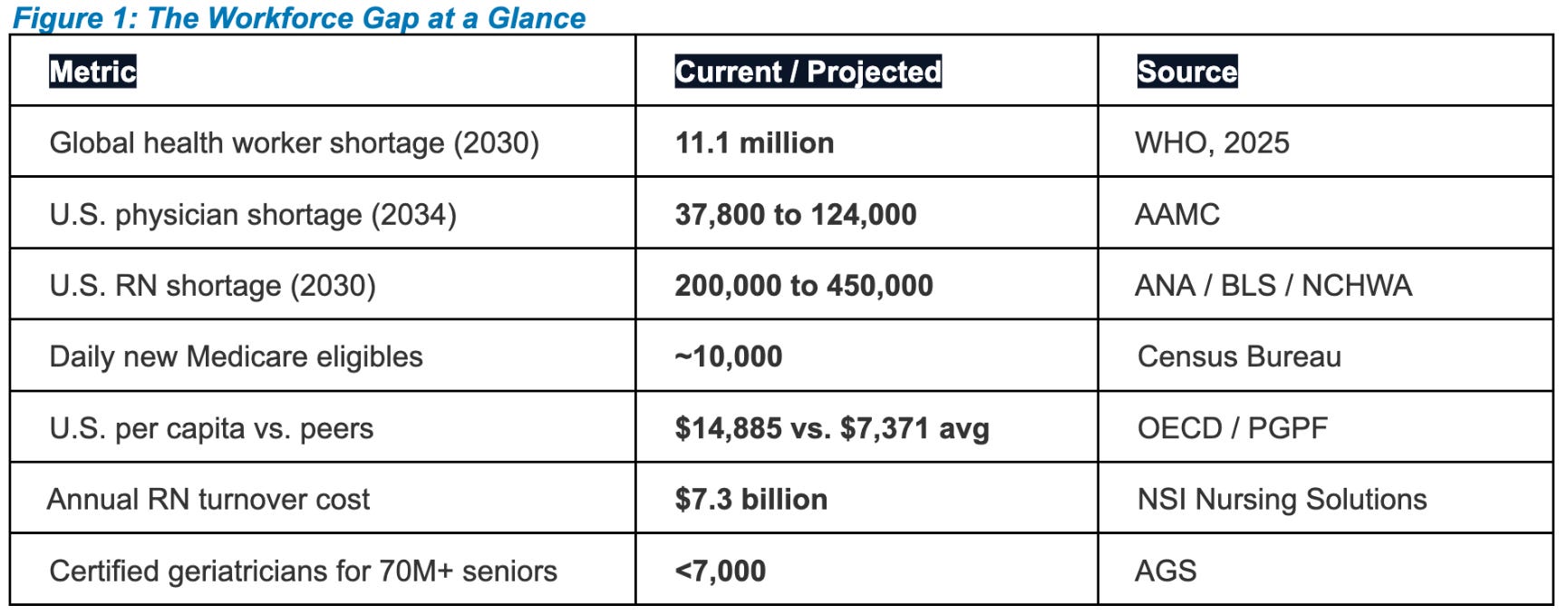
The demand curve compounds from four directions. Ten thousand Americans turn 65 every day. Chronic disease accounts for 90% of spending with no plateau. Improved diagnostics are identifying more disease earlier, adding patients to an overwhelmed system. Behavioral health demand surged post-pandemic against a deficit of 150,000+ mental health professionals.
The supply side is structurally broken. Medical schools expanded enrollment 40% since 2002, but federally funded residency slots have been frozen since 1997. Nursing programs turned away 91,000 qualified applicants in 2022 for lack of faculty and clinical sites. Over 138,000 nurses have exited since 2022, and 40% intend to leave by 2029. International recruitment is drying up as every country competes for the same clinicians.
II. What AI Can Do Now, and What’s Coming Faster than You Can Imagine
The pace of AI advancement has shifted from annual product cycles to continuous capability expansion. What arrives next is not a distant research agenda. It is weeks and months away.
“Powerful AI (AI that performs at expert level across a broad range of cognitive tasks) could come as early as 2026.” ... “Models substantially smarter than almost all humans at almost all tasks by 2026–2027.”
— Dario Amodei, CEO, Anthropic (Lex Fridman, Nov 2024; Senate testimony, Oct 2025)
The Architecture Shift
Agentic AI is the next inflection. These systems can reason, plan, and act proactively and autonomously across multi-step workflows. In one example, that means an AI can coordinate a patient’s discharge across pharmacy, home health, and follow-up scheduling without a human orchestrating each handoff. Every frontier lab is building agentic capability as a core priority. Nvidia’s 2026 GTC (the developer’s Woodstock for AI) will be showcasing a number of Claw use cases that further exemplify the potential of agents that are self-acting with little direction.
Mixture-of-experts (MOE) architectures route tasks to specialized sub-models that deliver higher accuracy at lower compute cost. This is how large models become both smarter and cheaper at the same time, and it is what makes sophisticated AI economically viable at the scale healthcare demands.
Recursive self-improvement is the frontier that will reshape every timeline in this paper. AI systems are beginning to improve their own architectures, training data, and reasoning processes without human intervention. Google DeepMind AlphaEvolve already designs and optimizes algorithms through evolutionary iteration. Frontier labs are automating large fractions of their own AI research, and within the next 12 to 18 months, the effective “workforces” of these labs will expand from thousands of human researchers to hundreds of thousands of AI agents, each focused on making the next model better than the last. Tyler Cowen, who runs Marginal Revolution, one of the most widely read economics blogs in the world, has observed that OpenAI compressed what used to be a six-month release cycle into two months, and that pace is accelerating. For healthcare, the implication is stark: the AI capabilities available to your organization next year will be substantially more powerful than what is available today, and the months after that will be another leap entirely.
World models learn using text, vision, audio, video, sensor data, spatial/physical interactions across multiple modalities simultaneously, the way humans do. The next generation of foundational models are building internal representations of how systems work, not just pattern matching against training data. Applied to clinical medicine, these models will reason about patient physiology the way experienced clinicians do, updating their understanding continuously as new data arrives. Combined with advances in self-auditing, where models verify their own outputs against internal consistency checks before presenting conclusions, reliability in clinical settings is approaching the threshold required for autonomous operation in bounded domains.
Contemporary and Emerging Use Cases
Ambient Clinical Documentation
Physicians spend two hours documenting for every hour with patients.¹ Ambient AI tools, including DAX Copilot, Abridge, Suki, and Heidi Health, listen to patient conversations, generate structured clinical notes, and auto-populate EHR fields. At Sanford Health, 88% of physicians reported reduced burnout, 90% improved satisfaction, 95% reduced cognitive load, and 100% said they would not give up the tool. If ambient documentation saves the average physician one hour per day, the aggregate productivity gain across roughly one million active U.S. physicians is equivalent to adding approximately 50,000 physician FTEs without training a single new doctor.
Abridge, an NVIDIA Inception startup and NVentures portfolio company, was recently awarded a contract from the U.S. Department of Veterans Affairs and is deployed in over 100 health systems (see NVIDIA: US Healthcare AI Agents). Heidi Health, founded in Melbourne, Australia, has scaled to over 81 million medical consultations across 190+ countries, supporting multilingual documentation, automated clinical coding via retrieval-augmented generation, and specialty specific templates. With $96.6M in funding and partnerships spanning New Zealand’s public health system, Telstra Health, and U.S. providers, Heidi demonstrates how global innovation is accelerating this category far faster than incumbents anticipated.
“We are well past the point where the complexity of modern medicine exceeds the capacity of the unaided expert mind. I can never keep up with everything, but a computer that can synthesize way more information than I ever could? The democratization of access to scarce medical expertise is a huge benefit.”
— Dr. Jonathan Chen, Stanford Medicine, AI & Clinical Informatics
Patient Engagement: Knowing More Than the Patient Knows
AI-powered engagement is moving well beyond appointment reminders. The next generation combines consumer, health, and behavioral data to build comprehensive patient profiles enabling predictive outreach, proactively contacting seniors during heat waves, flagging medication non adherence before it causes hospitalizations, delivering n-of-1 micro-segmented messaging calibrated to each patient’s communication preferences and health literacy. On the provider side, AI-generated EMR summaries synthesize years of longitudinal data into concise, actionable briefs that clinicians actually use when seeing patients.
Diagnostic Imaging, Pathology, and Predictive Analytics
The FDA has cleared over 700 AI-enabled medical devices, with radiology the largest category.² Viz.ai (stroke), Paige (pathology), and Aidoc (triage) are in clinical production. Predictive models identify patient deterioration, sepsis risk, and readmission probability hours before traditional assessments. At Kaiser Permanente and Geisinger, refined models demonstrate measurable reductions in ICU transfers and mortality.
“Imagine if any human on Earth could get a lung screening scan just by walking into a room and being autonomously led through that experience. Humans, instead of reading images, are thinking about patient needs and helping patients make decisions.”
— Kimberly Powell, VP of Healthcare, NVIDIA (GTC 2025)
Drug Discovery, MedTech, and the Regulatory Opportunity
Insilico Medicine reduced target-to-candidate timelines from 4–5 years to 13 months. Lilly and Roche are building data centers with NVIDIA presumably to improve near-term manufacturing and distribution efficiency and ultimately drug disscovery. Moon Surgical, Intuitive, GE HealthCare, and Synchron are pushing surgical robotics, autonomous imaging, and brain
computer interfaces. Physical AI may be the most exciting innovation frontier. The FDA should adopt AI to accelerate its own device review, improve post-market surveillance, and enable adaptive regulatory pathways.
Administrative Automation
Administrative burden accounts for 30% of spending, roughly $1.6 trillion annually.³ AI automates prior authorization, coding, scheduling, claims adjudication, and patient communication. At Mayo Clinic, 34 AI-powered “virtual workers” handle millions of revenue cycle tasks. Deloitte estimates GenAI gives nurses 20% more time for direct patient care.
The Epic Question
Epic holds records on approximately 80% of Americans and 90% of the best-financed health systems. The company has 125+ AI features live or in development, with 150+ more planned for 2026. Roughly two-thirds of Epic providers are already using generative AI features. That is enormous reach. But Epic was designed as a closed ecosystem, and closed ecosystems create both dependency and vulnerability. As health data becomes fully interoperable and emerging open technologies mature, superior analytic solutions may disrupt many of Epic’s commercial AI offerings. Health system leaders should be asking who disrupts the incumbents, and whether they are positioned to benefit when that disruption arrives.
The Payer Transformation
This transformation extends well beyond providers. Payers gain from AI-enabled prior authorization automation, claims adjudication, fraud detection, and population health analytics. But the deeper opportunity is strategic. The same granularity of member data and market transparency that AI enables will fundamentally reshape how payers go to market and manage their business. AI-driven customer intimacy, micro-segmented offerings calibrated to individual member needs and risk profiles, has yet to be fully imagined. There will be fundamental business model shifts, significant cost compression, and opportunities for meaningful margin expansion. Payers without AI capabilities will find themselves at a structural data disadvantage in provider negotiations and unable to validate or challenge provider-reported outcomes.
III. The Economics: Winners and Losers
Every capability described in the previous section connects to a financial outcome. AI in healthcare is not a technology initiative. It is the most consequential economic event in the industry since the introduction of managed care. The organizations that understand this build structural advantages. The organizations that treat AI as an IT project fall behind.
How AI Creates Financial Winners
Do more with less. AI augments existing clinical and administrative staff, expanding effective capacity without proportional headcount growth. Ambient documentation returns 50,000 physician-equivalent FTEs to the system. Predictive analytics enable proactive interventions that prevent costly acute episodes. Administrative automation reduces the $1.6 trillion annual burden. The compounding effect: better cost structure, higher throughput, and improved patient satisfaction, simultaneously.
Improve outcomes while reducing cost. AI-enabled clinical effectiveness identifies which protocols produce the best results for specific populations, reducing unwarranted variation, length of stay, complications, and readmissions. Organizations that demonstrate superior outcomes attract patients, clinicians, and payer contracts.
Capture new revenue streams. AI creates revenue opportunities beyond traditional fee-for service: performance-based payer contracts that reward measurable outcomes, population health management services, AI-enabled remote monitoring programs, predictive wellness offerings, and consulting services to smaller systems that lack AI infrastructure. Value-based arrangements become financially viable because AI provides the analytics and coordination infrastructure they have always required.
Workforce retention and recruitment advantage. Clinician burnout drives turnover, and turnover is expensive: $56,300 per RN departure, $7.3 billion annually for hospitals, and physician replacement costs exceeding $500,000. When AI reduces documentation burden and cognitive load, retention improves. That is a direct financial return. And the next generation of clinicians will choose employers based on the quality of their tools, just as software engineers choose companies today.
Margin expansion through operational intelligence. AI optimizes bed management, OR scheduling, supply chain, and staffing models. It identifies revenue leakage in coding and billing. It reduces denials and accelerates collections. Each of these individually moves margin by basis points. Compounded across a health system, the aggregate impact is transformative.
How AI Creates Financial Losers
Margin compression from unaugmented labor costs. Without AI augmentation, health systems face rising labor costs with limited offsetting productivity gains. Travel nursing premiums, overtime, and agency staffing shift from episodic to structural. For organizations that do not adapt, margin compression becomes increasingly difficult to avoid.
Loss of competitive positioning for talent and patients.Clinicians leave for organizations where technology reduces their burden. Patients follow quality data and access. This creates a vicious cycle: the systems most in need of relief are least likely to retain it.
Exclusion from performance-based contracts. As AI-enabled competitors demonstrate superior outcomes, payer contracts migrate toward those organizations. Systems without analytical infrastructure to manage risk, prove outcomes, and automate reporting get left behind.
Falling behind on quality benchmarks. AI-enabled systems continuously improve outcomes data, resetting quality benchmarks upward. Systems without AI-driven quality improvement find themselves below the curve, affecting public reporting, payer negotiations, and community trust.
Mission at risk. Health systems exist to serve their communities. An organization struggling to recruit staff, manage costs, improve outcomes, and maintain access faces questions about whether it can sustain its mission over time. AI is increasingly a factor in the difference between mission fulfillment and mission erosion.
IV. The Roadmap: Technology, Leadership, and Transformation
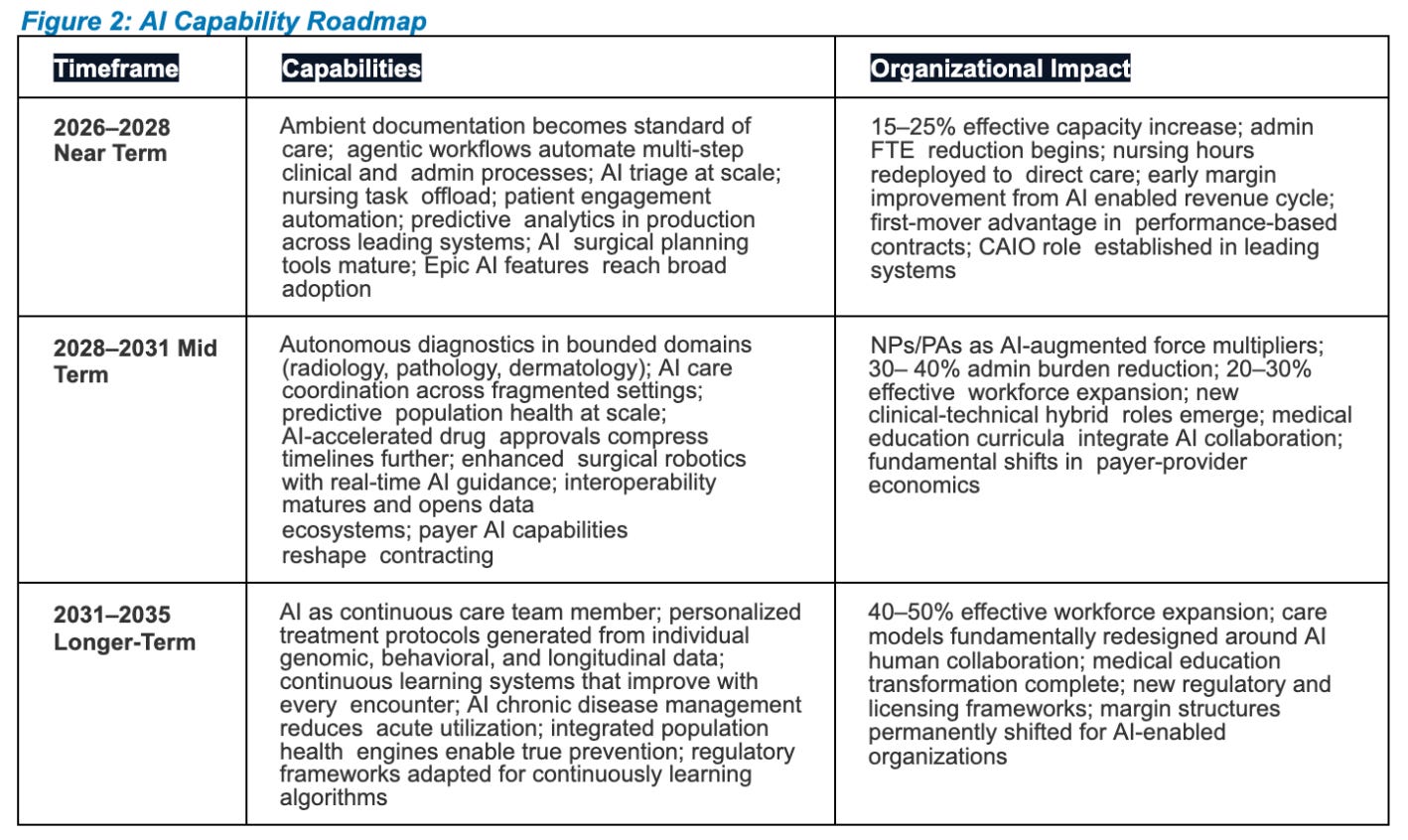
Leaders need realistic projections to build infrastructure and culture for what is coming. But a roadmap without organizational transformation is a wish list. This section addresses both: where the technology is headed and what organizations must change to capture it.
From Know-It-All to Learn-It-All
Satya Nadella’s transformation of Microsoft from a $300 billion company to a $3 trillion company was built on replacing the organization’s “know-it-all” culture with a “learn-it-all” culture. Health systems are filled with brilliant people who have spent decades mastering their domains. The AI imperative requires leaders who can say, “We know how to deliver care, and we are ready to learn how to deliver it differently.”
“AI is technology’s most important priority, and healthcare is its most urgent application.”
— Satya Nadella, CEO, Microsoft (April 2021, Nuance acquisition)
Marc Andreessen: “The future is going to be built by people who are optimists, not by people who are pessimists.” That is a direct challenge to the risk-averse governance model that characterizes most health system boards.
C-Suite Governance and Data Infrastructure
AI should become a standing board agenda item with direct CEO accountability. Leading organizations are establishing Chief AI Officer roles at the intersection of clinical operations, data strategy, and transformation. Investing in data quality, interoperability (FHIR, real-time APIs), governance frameworks, and explainability is essential. AI is only as good as the data it consumes, and clinicians are unlikely to trust tools they cannot understand.
“Sanford Health has made sustained investments in data infrastructure, analytics, interoperability and security to support responsible AI deployment.”
— Brad Reimer, CIO, Sanford Health
Medical Education Transformation
Michael Dowling, former CEO of Northwell Health (89,000 employees), demonstrated radical reform at the Zucker School of Medicine: students earn EMT certification in the first nine weeksand are deployed in ambulances from day one. Medical education is experiential, team based and supported by life like simulations. “Why have these medical school students spend their time memorizing when universal intelligence is at our fingertips?” He also created a healthcare-focused high school in Queens to build the workforce pipeline from adolescence. AI literacy must be woven into these pipelines from the start.
“Eventually, doctors will adopt AI and algorithms as their work partners. This leveling of the medical knowledge landscape will lead to a new premium: to find and train doctors with the highest level of emotional intelligence.”
— Dr. Eric Topol, Deep Medicine
Workforce Redesign
Culture. Create psychological safety for clinicians to experiment with AI without fear of punishment during adoption. This means leadership explicitly endorsing governance that supports a safe learning curve, celebrates early adopters, and treats initial friction as expected rather than as failure. Organizations that penalize imperfect AI adoption will get no adoption at all. The goal is a culture where clinicians feel ownership over the tools rather than subjugation to them.
“We have two jobs: one is to support technology for the world’s best hospital. The second is to innovate at Silicon Valley speed and put solutions into production.”
— Cris Ross, CIO, Mayo Clinic
Reporting. AI governance reports to the CEO or CAIO, not buried in IT. When AI strategy sits three levels below the C-suite, it becomes an implementation detail rather than a strategic priority. The CAIO role should sit at the intersection of clinical operations, data strategy, and enterprise transformation, with a direct line to the board and a seat at the operating committee.
Metrics. Measure AI adoption rates, clinician time recovered, outcomes improved, and revenue impact alongside traditional volume metrics. What gets measured gets managed, and most health systems are still measuring AI by pilot count rather than enterprise value. Effective metrics tie AI directly to margin improvement, clinician satisfaction scores, patient throughput, and quality benchmarks that affect payer contracts.
Training. Continuous learning infrastructure, not one-time workshops. AI capabilities evolve quarterly, and training programs that were current six months ago may already be outdated. Invest in dedicated AI champions within clinical departments who bridge technology and practice, and build peer-learning networks where early adopters coach colleagues. The organizations that treat AI literacy as an ongoing competency, like clinical skills, will outpace those that treat it as a one time onboarding event.
New roles. Clinical informaticists, AI-human workflow designers, and data governance specialists. These are not IT positions. They are clinical-technical hybrid roles that require fluency in both domains. Organizations that build these capabilities internally gain a structural advantage over those that outsource them, because the knowledge of how AI integrates into specific clinical workflows is proprietary and compounding. Early investment in these roles creates institutional knowledge that competitors cannot easily replicate.
The Cultural Reckoning: The Safety Double Standard
In previous work, we examined the attitudinal barriers to AI adoption.⁴In healthcare, these are amplified by embedded autonomy, hierarchy, and caution about patient safety. This is the John Henry problem applied to medicine.⁵ The instinct to race the machine is powerful. But the current system is already unsafe. Staffing shortages, burnout, and cognitive overload contribute to medical errors and preventable deaths every day. The question is not whether AI introduces risk. The question is whether AI is safer than the status quo.
THE SAFETY DOUBLE STANDARD
Consider the public reaction when a single fatality occurred in an autonomous vehicle: immediate calls to ban the technology, congressional hearings, months of media coverage. Meanwhile, approximately 40,000 Americans die in car accidents every year driven by humans, a toll society accepts as normal. Healthcare faces the same asymmetry. A single AI diagnostic error will generate headlines. The thousands of diagnostic errors, missed findings, and preventable deaths caused by overworked, understaffed, burned-out clinicians every year barely register. The standard for AI should not be perfection. It should be: is AI safer than the status quo?
V. The Imperative: Why Now
The system’s long-demonstrated ability to absorb punishment and keep functioning has reached its limits. The workforce pipeline cannot produce what the system needs. The financial model, $5.3 trillion and growing at 5.8% annually toward $8.6 trillion by 2033, is approaching political and economic limits. The U.S. spends $14,885 per capita on healthcare versus $7,371 among wealthy OECD peers, with worse mortality outcomes driven by chronic disease, substance abuse, and systemic access disparities.⁶
“Health care confronts us with a difficult test. We have never corrected failure in something so deeply embedded in people’s lives and in the economy without the pressure of an outright crisis.”
— Dr. Atul Gawande
This is an innovation imperative. It is also, increasingly, a moral one. Healthcare organizations exist to care for people. When the technology exists to reduce diagnostic errors, extend access to underserved populations, return clinicians to the bedside, and identify disease before it becomes catastrophic, failing to adopt it is not prudent caution. It is a failure of the obligation that every healthcare leader accepted when they entered this field. The Hippocratic tradition demands that clinicians use every tool available to serve their patients. That obligation now extends to the organizations those clinicians work for.
THE INNOVATION IMPERATIVE
“AI has the potential to impact every aspect of health and medicine. We have to act with urgency to ensure that this technology advances in line with the interests of everyone, from the research bench to the patient bedside and beyond.” — Dr. Lloyd Minor, Dean, Stanford University School of Medicine
The scarcest resource in healthcare is human expertise. AI can democratize access to that expertise for the tens of millions in the United States who struggle to reach a specialist, obtain a timely diagnosis, or get the care they need. Organizations that move decisively in 2026 to 2028 will be well positioned to define the next era. They will attract clinicians who want environments where technology reduces burden. They will deliver better outcomes at sustainable costs. They will fulfill their missions of serving the communities that depend on them.
Those that wait risk being defined by their hesitation.